Event-Driven Messaging
Core Idea
Examples and diagrams in this page follow the shared Hypothetical Scenario.
Event-driven messaging is a service interaction style where capability outcomes are emitted as events and processed by subscribers. The style shifts many cross-service flows from direct request chains to asynchronous message exchange. This shift changes architecture behavior in a deep way. Latency paths change. Failure paths change. Consistency timing changes. Observability design changes.
From an architecture view, event-driven messaging is not only a transport choice. It is a coordination model. Services publish domain facts. Other services react through contracts and local state transitions. The model can increase autonomy and scale. The model can raise consistency and governance complexity.
This page covers that tension in detail. The page includes SAGA patterns and distributed transaction strategies.
Historical Context
Messaging middleware became a major enterprise integration mechanism in the 1990s. Garcia-Molina and Salem introduced the SAGA model in 1987 for long-lived transactions. Gray and Reuter documented transaction processing foundations that shaped distributed transaction thinking. Modern event streaming platforms expanded event-driven architectures in large-scale systems.
Sources: Garcia-Molina and Salem (1987), Gray and Reuter (1992), Hohpe and Woolf (2003)
The Problem It Solves
Synchronous service chains can create fragile runtime coupling. Service A waits on Service B. Service B waits on Service C. One slow dependency can stall the chain. One outage can trigger cascading failures.
Cross-service business flows then become risky. A reservation workflow can span profile, listing, payment, and notification capabilities. A direct synchronous transaction across all services is rare in practice. Network partitions, retry storms, and independent deployment cycles make this hard.
Event-driven messaging addresses these conditions. It decouples producer and consumer runtime. It lets services progress with local transactions and message handoff. It gives architecture space for eventual consistency with explicit recovery patterns.
Typical platform flows that benefit:
- recommendation brief generation from many data sources
- listing lifecycle updates propagated to many bounded contexts
- ownership cost recomputation after market feed changes
- fraud signal enrichment from independent analyzers
Main Concept
The architectural building blocks are clear.
- Event producer: service that emits a fact after local state transition
- Event channel: topic, queue, or stream that carries event records
- Event consumer: service that handles subscribed event types
- Event contract: schema and semantic rules for each event type
- Delivery semantics: at-most-once, at-least-once, or effectively-once behavior
- Ordering scope: global, partition, or key-based ordering guarantees
A producer commits local state and emits event data. A consumer applies local logic and local transaction boundaries. Cross-service consistency is achieved over time through event flow.
Two architecture concerns define success.
-
Contract governance Event schemas and semantics need version discipline. Fields need evolution rules. Meaning changes need migration policy.
-
Idempotent processing Duplicate delivery can occur in real systems. Consumers need idempotency keys and replay-safe handlers.
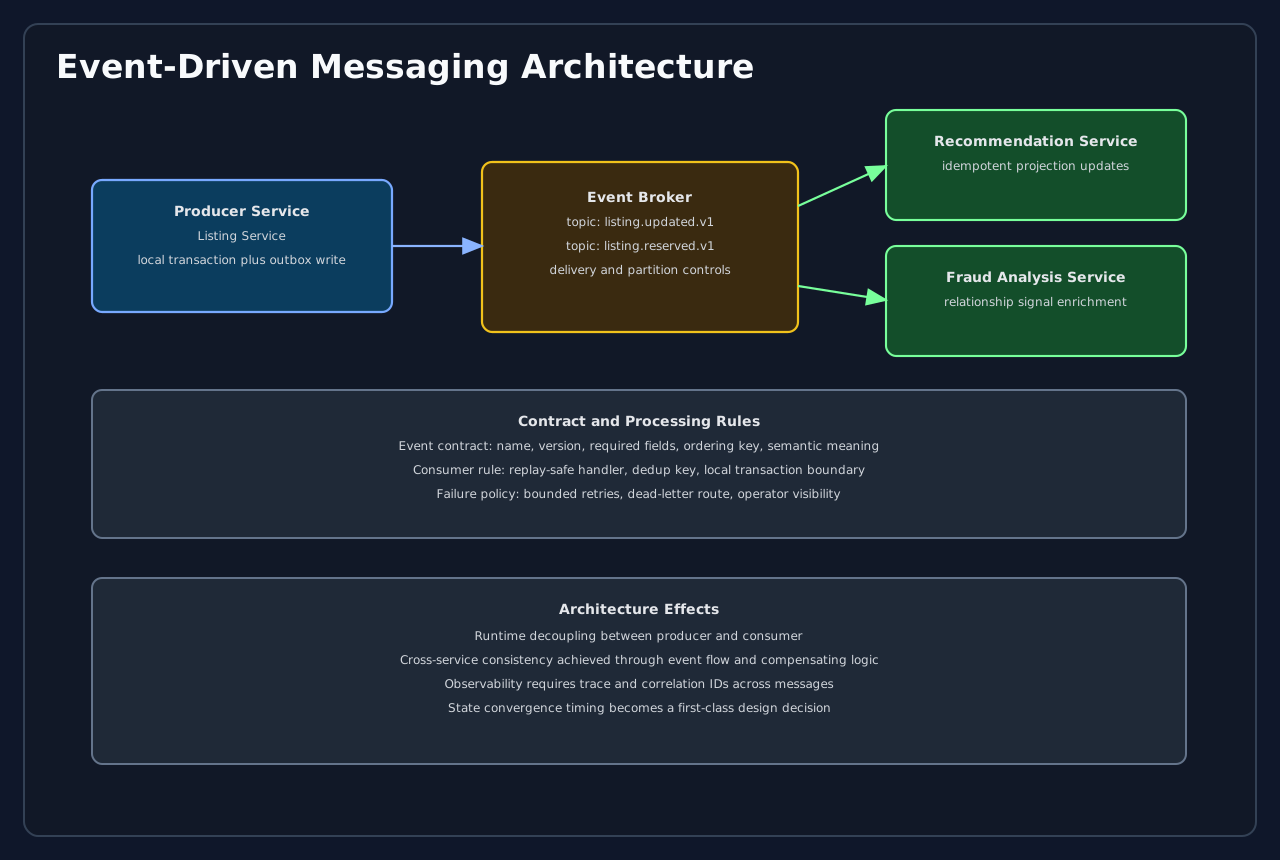
This diagram shows producer, broker, consumers, and contract boundaries.
SAGA Patterns
A SAGA coordinates multi-step business transactions through local transactions and compensating actions. Each step commits local state. If a later step fails, compensation steps reverse prior effects where possible.
Two common SAGA forms:
- Choreography saga: services react to events with no central coordinator
- Orchestration saga: one coordinator sends commands and tracks step state
Choreography gives high autonomy. It can drift into hidden flow complexity when step count grows. Orchestration gives explicit flow control. It can create central coordinator coupling and lifecycle burden.
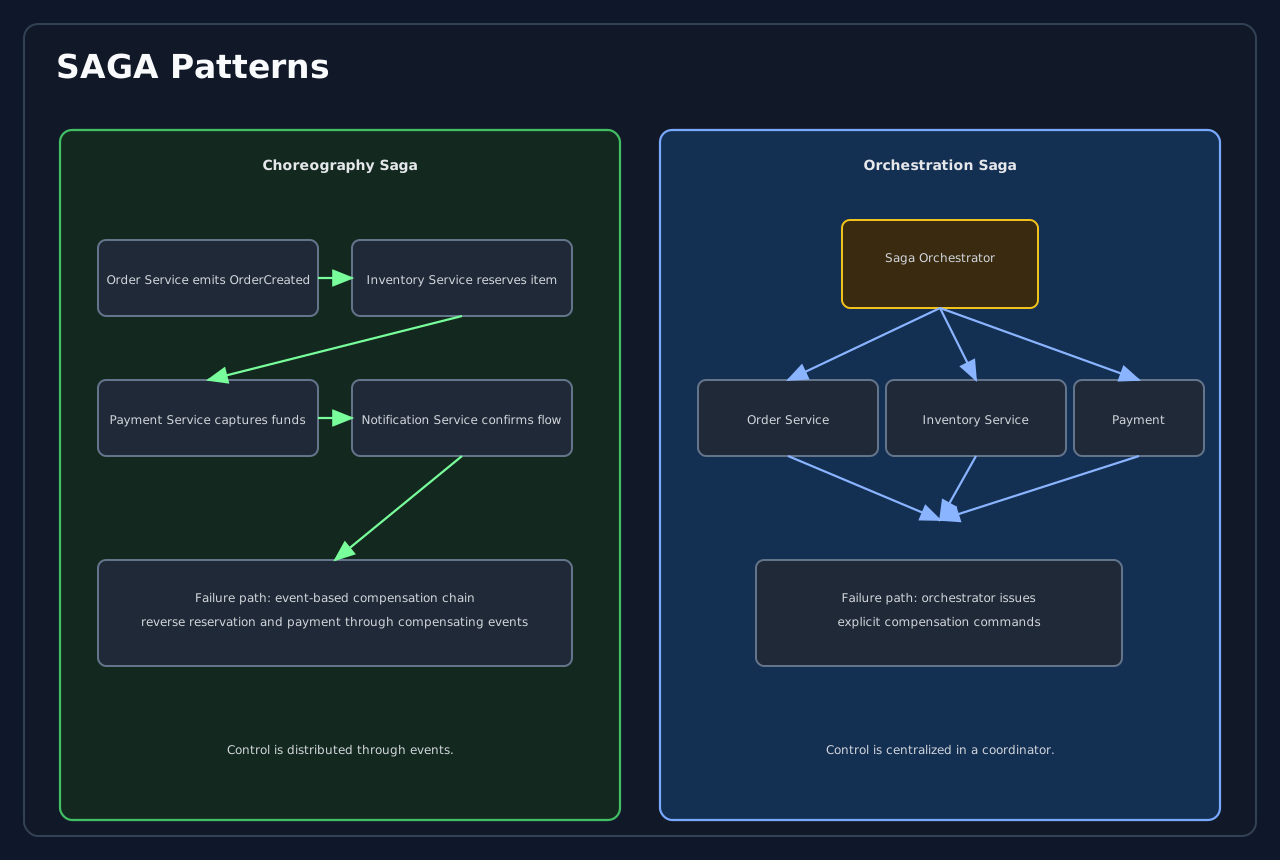
The diagram compares control flow and failure handling across both forms.
Distributed Transactions
Distributed transactions aim for cross-resource consistency across boundaries. Architecture teams often compare three strategies.
-
Two-Phase Commit (2PC) Coordinator asks all participants to prepare. Then commit or rollback decision is broadcast. This gives strong atomic semantics. The model can reduce availability and increase lock duration under faults.
-
SAGA with compensation Each step commits locally and emits next action. Compensations restore business consistency for failed paths. This gives stronger availability and autonomy. It requires explicit compensation design and visibility tooling.
-
Outbox plus relay pattern Service writes domain state and outbox record in one local transaction. A relay publishes outbox records to the broker. This reduces dual-write risk between database and broker.
No single strategy fits every operation class. Architecture decision must follow transaction semantics and business risk of inconsistency windows.
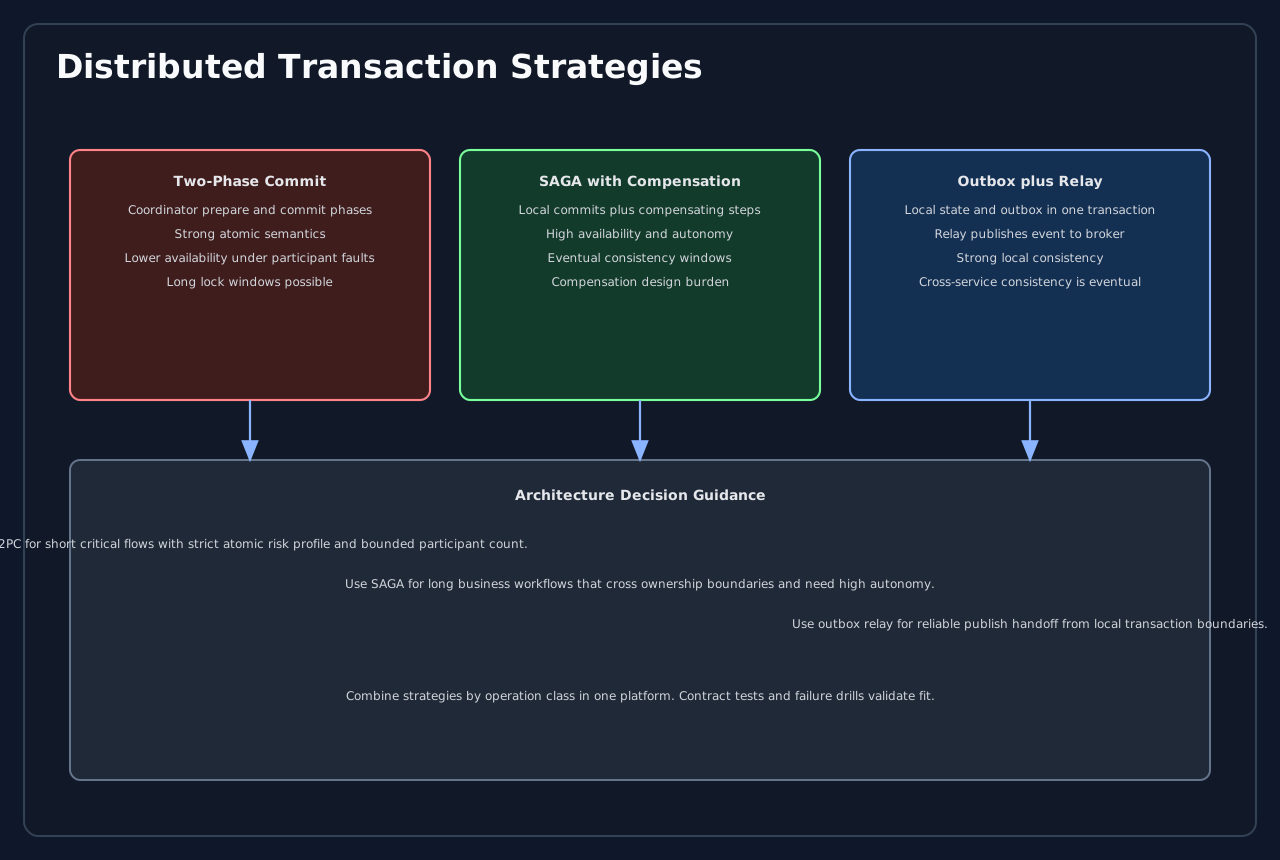
The map compares 2PC, SAGA, and outbox-driven coordination.
How It Works
A practical implementation sequence can keep architecture risk under control.
Step 1. Classify operation semantics. Mark flows that need strict atomic behavior. Mark flows that accept eventual consistency windows.
Step 2. Define event contracts. Define event name, version, required fields, semantic meaning, and ordering key.
Step 3. Define producer boundary. Use local transaction plus outbox record for publish safety.
Step 4. Define consumer idempotency model. Store processed message keys or deduplicate through business keys.
Step 5. Define failure policies. Set retry windows, dead-letter routing, and poison message handling.
Step 6. Choose SAGA form for multi-step workflows. Use choreography for short flows with clear bounded contexts. Use orchestration for long flows with many conditional branches.
Step 7. Add observability contract. Trace IDs, correlation IDs, and saga instance IDs must travel across messages.
Step 8. Add architecture tests and chaos tests. Validate duplicate delivery handling, replay safety, and compensation paths.
A decision table helps architecture selection.
| Decision Lens | 2PC | SAGA | Outbox plus Relay |
|---|---|---|---|
| Cross-service atomicity | Strong | Eventual | Local strong, cross-service eventual |
| Availability under partitions | Lower | Higher | Higher |
| Operational complexity | High | High | Moderate |
| Compensation design need | Low | High | Moderate |
| Fit for long-running workflows | Low | Strong | Strong with orchestration |
Challenges and Shortcomings
Event-driven messaging can hide complexity under asynchronous decoupling. Flow visibility can degrade if trace discipline is weak. Data drift can appear when contract governance is weak. Replay can cause unintended side effects when handlers are not idempotent.
SAGA compensation can be hard for irreversible external actions. Payment capture and external notification channels can require explicit exception policy. Teams need operational playbooks for partial-failure states.
Distributed transaction choices carry cost tradeoffs. 2PC can block progress under participant failure. SAGA can expose temporary inconsistency windows. Outbox relay can add delay between commit and publish.
Architecture success depends on explicit decision records, tests, and runtime controls.
Link to Existing Handbook Concepts
| Concept | Why? |
|---|---|
| Introduction to Services | Service capability boundaries define producer and consumer ownership. |
| Interaction Style Selection Framework | Event channels should be selected for fact propagation and asynchronous decoupling. |
| Service Contracts with REST | Synchronous contracts and asynchronous event contracts need aligned capability semantics. |
| The Database Dilemma | Transaction semantics and durability needs drive messaging and storage choices together. |
| Resilience and Recovery | Retry policy, dead-letter handling, and compensation paths are resilience mechanisms. |
| State and Data Modeling | Event schema evolution and invariant preservation depend on clear state models. |
| Modularity and Composition | SAGA flow is composition of focused service capabilities. |
Written by: Pedro Guzmán
See References for complete APA-style bibliographic entries used on this page.