REST Constraints and Goals
Core Idea
Examples and diagrams in this page follow the shared Hypothetical Scenario.
REST is an architectural style for distributed systems. It defines a set of constraints. A system follows the style only when it follows all required constraints. Each constraint shapes how clients and services exchange information. Together they drive a set of architecture goals.
This page explains each constraint in detail. This page then explains the goals of the style. The explanations use the car intelligence and marketplace scenario in this handbook. The analysis follows guidance from SOA with REST and the REST dissertation sources.
Historical Context
Roy Fielding formalized REST in 2000 as part of his doctoral dissertation. The work studied web architecture properties and constraint-driven system design. Thomas Erl and co-authors later connected REST style to service orientation patterns in enterprise delivery. Their work gave practical guidance for service contract design, capability exposure, and governance.
Sources: Fielding (2000) and Erl et al. (2012)
The Problem It Solves
Distributed systems can degrade through endpoint sprawl. One endpoint uses custom verbs. Another endpoint returns mutable session state. A third endpoint exposes backend details in payload shape. Soon the API surface loses consistency. Integration cost grows. Testing cost grows. Change cost grows.
REST addresses this risk through constraints. The constraints reduce protocol entropy. They enforce a predictable interaction model. Client teams then gain a stable contract model. Service teams gain clearer boundary rules. Operations teams gain better observability and cache control.
In enterprise systems this discipline matters. Service growth is expected. Consumer count is expected to rise. Without strict constraints, each service team creates local conventions. Those conventions conflict across the platform.
Main Concept
REST has six constraints. The first five are mandatory in standard REST style. The sixth is optional.
Client-Server
Client and server responsibilities stay separate. Client handles presentation and user interaction. Server handles business capability and state transitions. This separation allows each side to evolve with lower coupling.
In the car platform, a web client renders recommendation cards. The recommendation service computes match results. The client does not compute ownership cost rules. The server does not manage screen state.
Stateless
Each request carries all context required for processing. Server does not keep client session state between requests. State that defines workflow progress stays in resource representations, tokens, or external stores.
This constraint improves horizontal scale. Any service instance can process any request. Failure recovery paths stay simpler. Yet request payloads may grow. Token and idempotency design becomes important.
Cache
Responses must define cacheability clearly. A response can be cacheable or non-cacheable. When cache rules are explicit, clients and intermediaries can reuse representations. This reduces repeated load on services.
In the car platform, listing details and reliability snapshots can be cacheable for short periods. Checkout reservation responses should be non-cacheable. Cache policy is part of contract design, not a late optimization.
Interface or Uniform Contract
REST interaction uses a uniform interface model. Resource identification is explicit. Manipulation happens through representations. Messages carry self-descriptive metadata. Hypermedia can guide available transitions.
This constraint is the center of REST style. A uniform contract lowers client surprise. It improves portability across services. It supports clear consumer onboarding.
Layered System
A client cannot assume direct connection to the origin server. Interaction can pass through layers. Common layers include gateway, cache, auth proxy, and policy mediator. Each layer has a focused role.
Layering allows policy insertion with low disruption. A new rate control layer can be added with no client rewrite. A new observability layer can be added with no domain logic change.
Code-On-Demand
A server can transfer executable code to clients. This constraint is optional in REST. Typical examples include scripts for client extension behavior. Many enterprise APIs do not use this constraint. Still, it remains part of the formal style definition.
In security sensitive systems this constraint needs strict control. Runtime code transfer expands attack surface. Policy and trust boundaries must be explicit.
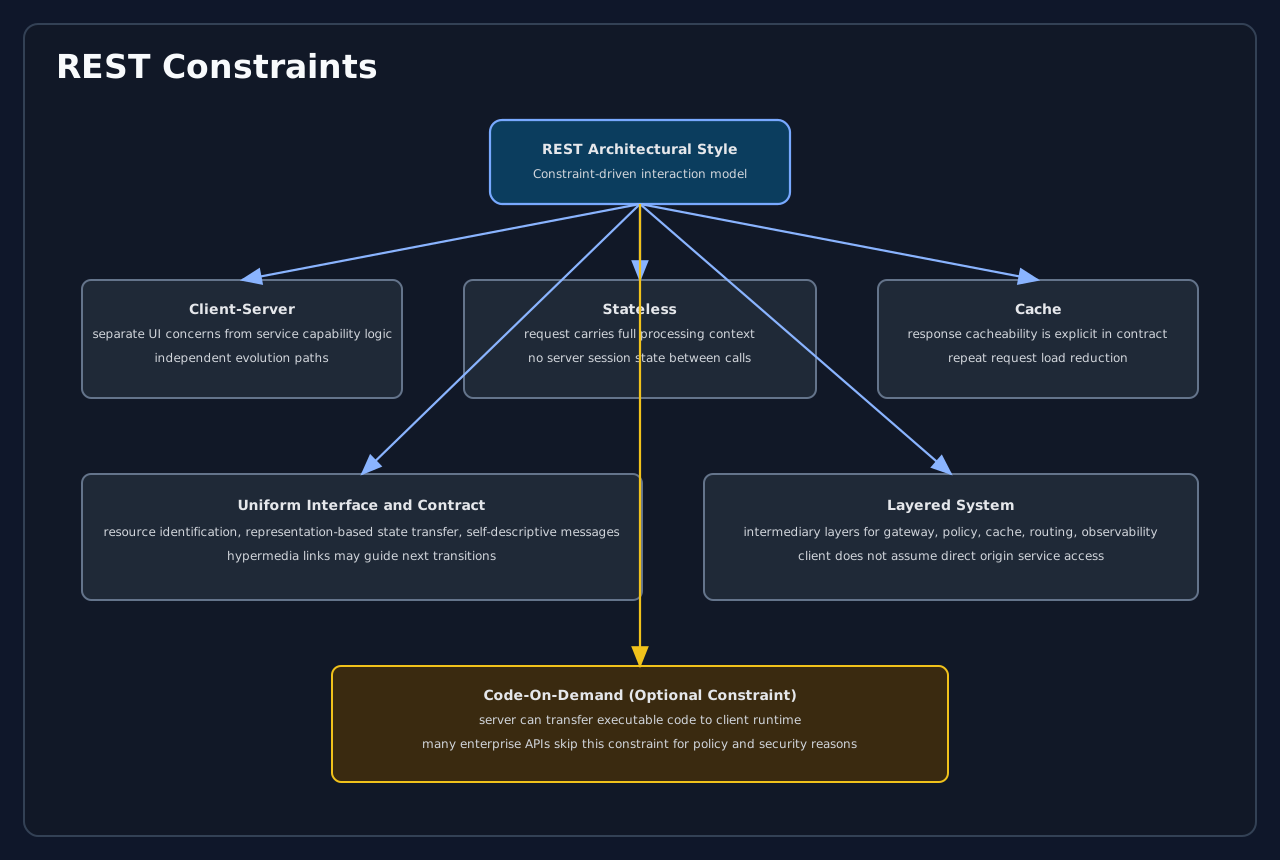
The map shows each constraint and the architectural pressure it creates.
How It Works
REST constraints lead to architecture goals. The goals are practical quality targets. Teams can measure them through design reviews and runtime metrics.
Performance
Cache control and stateless processing can reduce repeated server work. Layered caching can reduce latency on read-heavy capabilities. Request and response shape design still matters. Large payloads can erase cache benefits.
Scalability
Stateless requests and client-server separation support scale-out patterns. Service instances can be replicated with low coordination overhead. Cache layers reduce origin load during peaks.
Simplicity
Uniform contract rules reduce custom protocol behaviors. Consumer teams learn one interaction model. Service teams reuse one design vocabulary across capabilities.
Modifiability
Layered boundaries and client-server separation allow localized change. UI teams can change presentation with no server rewrite. Service teams can revise internal persistence with stable resource contracts.
Visibility
Self-descriptive messages improve runtime inspection. Gateways and observability tools can classify traffic with no deep service hooks. Operations teams can trace error classes and cache behavior through headers and status patterns.
Portability
Uniform resource and representation rules reduce client lock-in. A consumer that follows contract standards can call many services with similar handling logic. This supports multi-client ecosystems.
Reliability
Stateless processing supports retry and failover behavior. Layered control points support traffic shaping and fault isolation. Reliability still depends on idempotency design and contract clarity. No style constraint replaces engineering discipline for failure paths.
A practical mapping for the platform:
- recommendation queries: cacheable reads with strong contract metadata
- listing reservation: non-cacheable state transition with idempotency key
- profile updates: stateless request with explicit precondition checks
- composition orchestration: layered calls through gateway policy and tracing
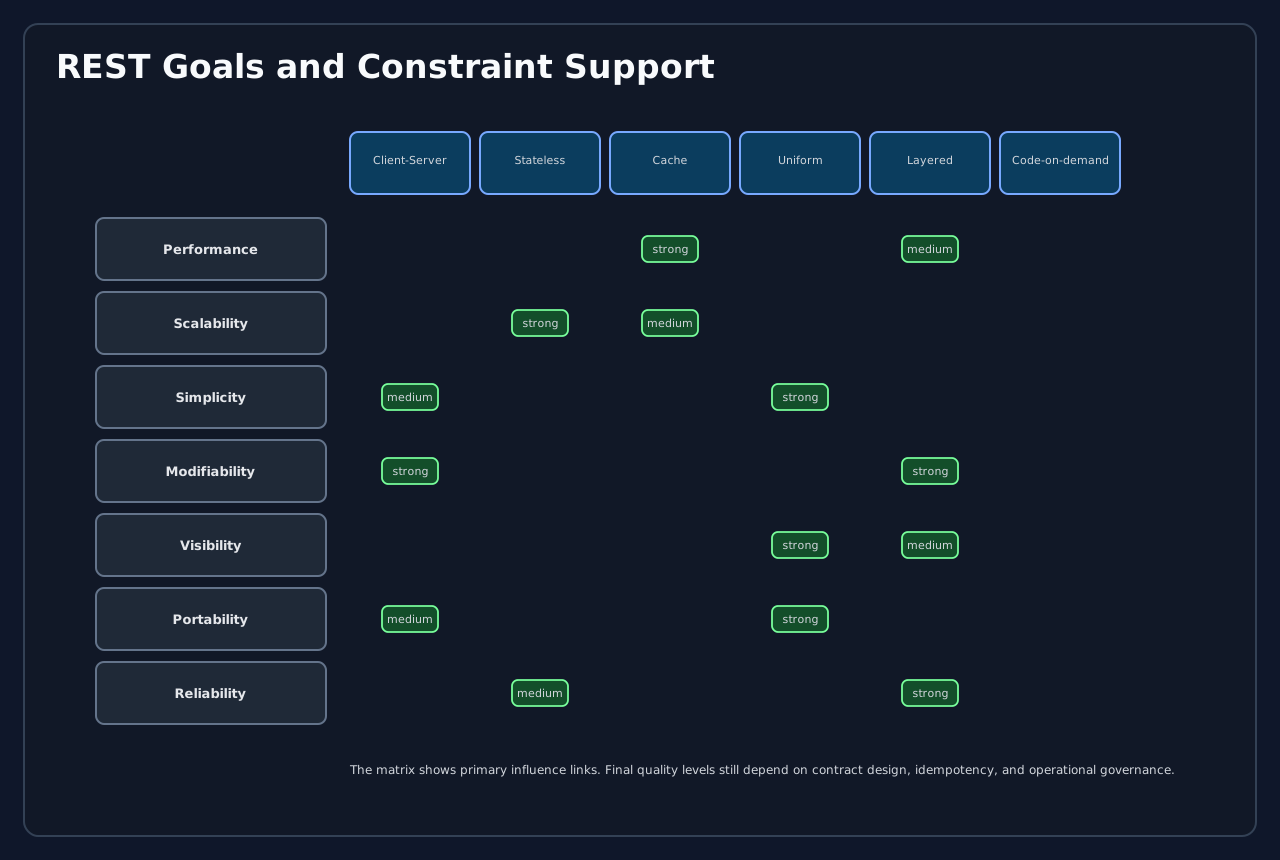
The diagram links each goal to key constraints that support it.
Challenges and Shortcomings
REST constraints improve consistency, yet tradeoffs remain.
A strict uniform contract can feel slow in teams used to ad hoc RPC endpoints. Statelessness can increase payload size and token handling burden. Layered systems can add latency at each hop. Cache invalidation remains hard in mixed read-write workflows.
Code-on-demand can conflict with strict security policy. Many enterprise teams avoid this constraint for that reason. When they do, they still gain value from the other constraints.
REST is not a full business architecture by itself. Service capability design, ownership governance, and data model strategy still require architecture decisions outside REST constraint list.
Link to Existing Handbook Concepts
| Concept | Why? |
|---|---|
| Introduction to Services | This page links directly to Introduction to Services. Service contract and service capability terms are applied through REST constraint rules. |
| Interaction Style Selection Framework | REST is one option in a broader interaction-style portfolio. |
| Hexagonal Architecture | REST handlers fit inbound adapters. Uniform contract rules define boundary behavior at driving ports. |
| Onion Architecture | Transport details stay in outer layers. Core capability logic stays in inner layers. |
| Abstraction and Boundaries | REST constraints define how contract boundaries remain clear at runtime. |
| Correctness and Testing | Contract tests should verify status semantics, cache headers, idempotency behavior, and representation stability. |
Written by: Pedro Guzmán
See References for complete APA-style bibliographic entries used on this page.