Service Contracts with GraphQL
Core Idea
Examples and diagrams in this page follow the shared Hypothetical Scenario.
A GraphQL service contract is the public schema boundary that defines what consumers can ask for and what the service promises to return. The contract is the schema, the operation model, and the runtime rules that govern execution. This includes type definitions, field semantics, nullability, authorization behavior, error envelopes, cost limits, and change policy.
In service orientation terms, GraphQL still follows the same core idea as REST. A service publishes capabilities through a contract. A consumer integrates with that contract. The service can revise internals without forcing consumers to learn private implementation details.
This page focuses on the contract model for GraphQL. It explains uniform contract elements, service capabilities, the difference between GraphQL contracts and non-GraphQL contracts, and the role of introspection and runtime query binding.
Historical Context
GraphQL emerged from production pressure in large client ecosystems where endpoint catalogs created payload mismatch and delivery friction. Public release in 2015 started a broad shift toward typed API schemas and contract-driven client tooling. The GraphQL specification then formalized execution, validation, type rules, and introspection behavior under open governance.
Sources: Facebook Engineering (2015), GraphQL Foundation (2021), and GraphQL over HTTP Working Group (n.d.)
The Problem It Solves
Contract design often breaks down in client-heavy systems. One product team needs five fields. Another team needs twenty fields plus nested objects. A third team needs the same objects with different shape and filtering rules. Endpoint growth then accelerates. Service teams add variants for each use case. Consumers couple to endpoint naming details. Evolution slows.
GraphQL contracts address this problem by moving variation into client query selection. A single schema can expose a broad but disciplined capability surface. Consumers request exact fields. Service teams govern one type system instead of many endpoint variants.
In the car intelligence and marketplace scenario, one consumer asks for reliability trends and maintenance cost ranges. Another consumer asks for listing price distribution and financing projection. A third consumer asks for profile match score and explanation factors. GraphQL can expose these capabilities through one schema with clear type ownership.
Main Concept
Uniform Contract Elements for GraphQL
A strong GraphQL contract has a consistent set of elements.
-
Schema type system Object types, input types, enums, interfaces, unions, and scalars define contract vocabulary.
-
Operation model
Query,Mutation, andSubscriptiondefine read, state change, and streaming capabilities. -
Field semantics Each field has business meaning, not only a technical shape. Descriptions and naming rules are part of contract quality.
-
Nullability and error semantics Nullability signals what is guaranteed. Error model defines partial success behavior and machine-readable failure data.
-
Authorization semantics Contract rules define who can call each capability and which fields require scope checks.
-
Complexity policy Depth limits, cost budgets, and operation allow lists protect platform stability.
-
Evolution policy Additive changes, field deprecation periods, and migration windows keep consumer upgrades predictable.
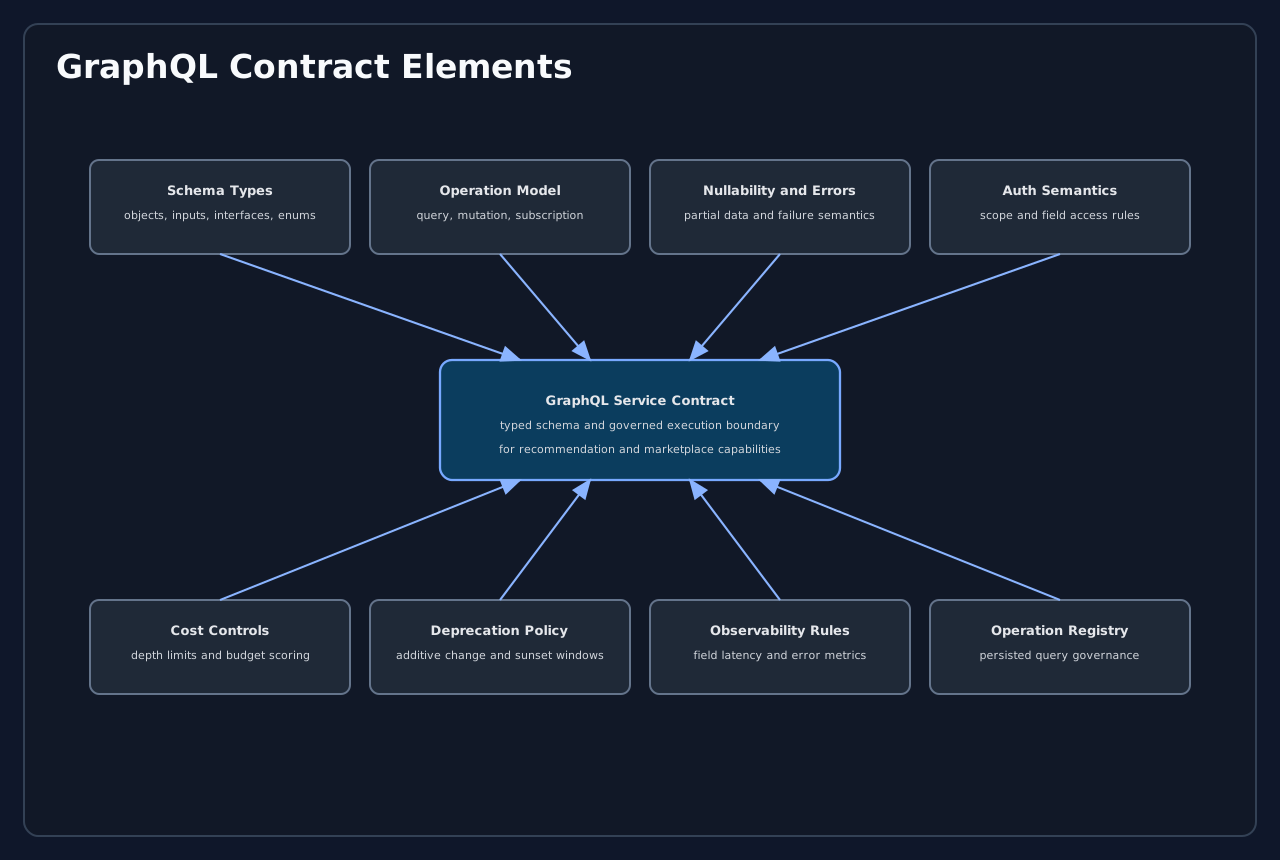
The diagram shows how these elements combine into one public boundary.
GraphQL Service Capabilities
A service capability is a function exposed through the contract. In GraphQL, capability boundaries can be modeled at field and operation level.
Example capability groups in the scenario:
- profile capabilities: user profile, lifestyle preferences, budget constraints
- recommendation capabilities: candidate vehicles, match explanation, confidence bands
- marketplace capabilities: listing summaries, price history, seller metadata, reservation intent
Capability design must stay cohesive. A schema that mixes unrelated responsibilities into one root object creates brittle boundaries. A schema with focused capability slices keeps ownership clear.
GraphQL Service Contracts
A GraphQL service contract includes:
- schema definition language and documented semantics
- operation behavior rules
- validation and authorization rules
- execution constraints and timeout policy
- versioning and deprecation policy
- observability requirements for field execution and failures
A contract is more than a .graphql schema file.
Runtime governance is part of the contract.
Consumer trust depends on execution predictability, not on syntax alone.
GraphQL Contracts versus Non-GraphQL Contracts
| Dimension | GraphQL Contract | Non-GraphQL Contract |
|---|---|---|
| Contract unit | Type system plus operation documents | Endpoint or procedure catalog |
| Data selection | Client chooses fields | Server chooses payload shape |
| Change model | Additive fields with deprecation flow | New endpoint versions or method variants |
| Validation model | Query validation against schema | Request validation per endpoint |
| Runtime risk | Query cost and resolver fan-out | Endpoint sprawl and payload mismatch |
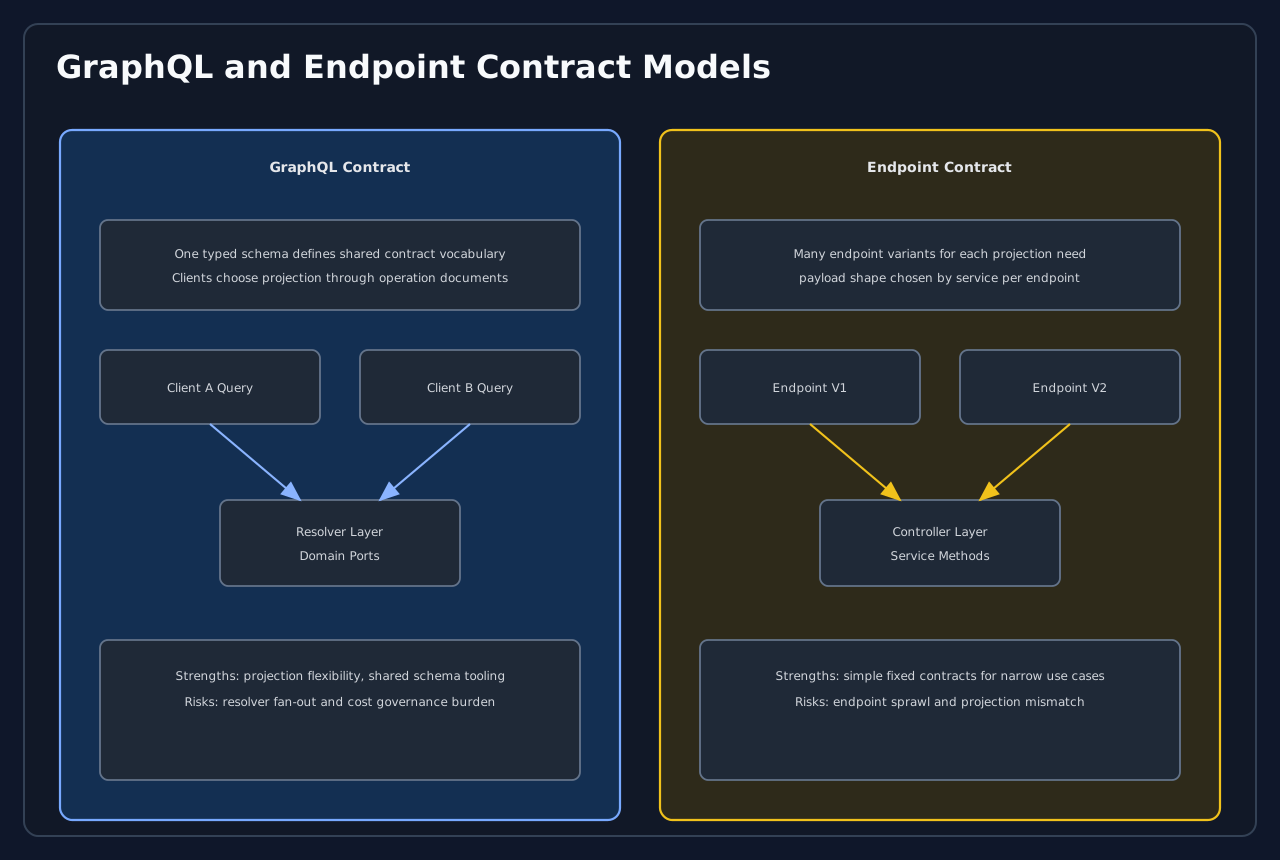
The diagram contrasts schema-driven interaction and endpoint-driven interaction.
Introspection and Late Binding in GraphQL Contracts
GraphQL introspection gives clients and tools direct access to contract metadata. This supports runtime discovery and type-safe code generation. A consumer can inspect available fields, argument types, and deprecation state.
Late binding in GraphQL means the client binds data shape at request time through operation documents. The consumer does not need a new endpoint for each projection. The consumer does need governance for operation catalogs and cost budgets.
In enterprise deployments, many teams pair introspection with persisted queries. Persisted queries keep runtime flexibility for data shape selection and still protect the platform from uncontrolled query forms.
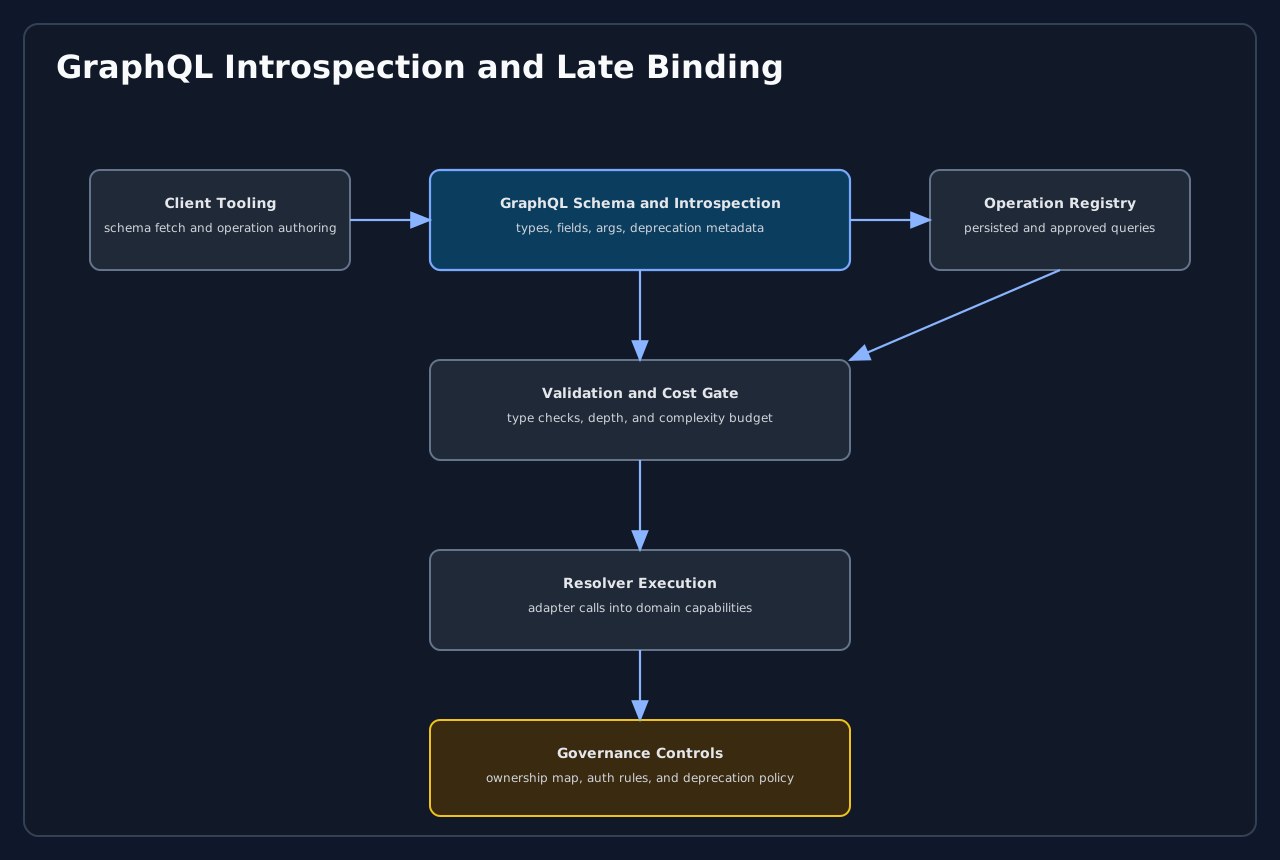
The diagram shows discovery, operation validation, and execution under contract governance.
How It Works
A practical rollout path for GraphQL contracts:
Step 1. Define service capability boundaries in domain language. Assign schema ownership to clear teams.
Step 2. Design schema types around stable business concepts. Avoid leaking persistence model details.
Step 3. Define operation entry points with explicit purpose. Keep mutation names aligned with domain actions.
Step 4. Define nullability and error envelopes with precision. Document when partial data can appear and what error codes mean.
Step 5. Define authorization and field-level access rules. Treat auth behavior as contract behavior.
Step 6. Define query cost rules. Set depth limits, field multipliers, timeout budgets, and reject policy.
Step 7. Add persisted query support for high-traffic operations. Use operation registry review in CI.
Step 8. Add contract tests and consumer compatibility tests. Validate schema changes against known consumer operation sets.
Step 9. Add observability standards. Capture per-field latency, resolver error rates, and cost budget violations.
Step 10. Enforce deprecation lifecycle. Publish timelines, monitor usage, then remove fields after migration completion.
This flow keeps schema flexibility and runtime safety in balance.
Challenges and Shortcomings
GraphQL contracts can improve consumer flexibility and still increase governance load. Schema centralization can attract unrelated capabilities. Resolver design can bypass domain boundaries in rushed implementations. Query cost control can lag behind feature growth.
Common failure cases:
- weak naming and ownership rules
- missing deprecation policy and stale fields
- missing complexity limits on public traffic
- authorization logic scattered across resolvers with no policy model
- low observability on field cost and resolver latency
GraphQL is a strong contract style for read-rich products with varied client projections. GraphQL is a weaker fit for narrow command APIs that require strict static request forms. Architecture teams should adopt it where the contract model matches product interaction shape.
Link to Existing Handbook Concepts
| Concept | Why? |
|---|---|
| Introduction to Services | Schema capabilities are service capabilities expressed in a typed contract form. |
| GraphQL Constraints and Goals | Contract elements in this page implement those constraints in practical architecture. |
| Service Contracts with REST | Both styles require strict contract governance and compatibility policy. |
| Interaction Style Selection Framework | GraphQL contract adoption should follow capability-level fit criteria. |
| Hexagonal Architecture | GraphQL resolvers are inbound adapters over driving ports. |
| Abstraction and Boundaries | Schema and resolver boundaries are abstraction boundaries for consumers. |
| Correctness and Testing | Contract tests must validate schema rules, auth behavior, and execution limits. |
Written by: Pedro Guzmán
See References for complete APA-style bibliographic entries used on this page.