Microservices Architectural Style
Core Idea
Examples and diagrams in this page follow the shared Hypothetical Scenario.
Microservices architecture structures a system as a set of independently deployable services aligned to business capabilities. Each service owns its runtime, data contracts, and operational lifecycle. Service boundaries are explicit. Cross-service communication happens through published contracts.
The style gives strong autonomy and scalability options. It introduces distributed systems complexity by default. Teams need maturity in observability, reliability, security, and contract governance. This pattern should be chosen for clear reasons, not trend alignment.
In the handbook scenario, recommendation, profile, marketplace, and analytics can evolve as separate services when ownership and scaling patterns diverge. The style helps where domain boundaries are clear and operational discipline is strong.
Historical Context
Service-oriented design predated modern microservices. The microservices term gained broad adoption in the 2010s through practical architecture reports and industry cases. The style emphasized small autonomous services, independent deployment, and strong automation. Experience reports later showed that success depends more on boundary quality and platform maturity than service count.
Sources: Lewis and Fowler (2014), Newman (2021), and Richardson (2019)
The Problem It Solves
Large monolithic systems can face coupled release cycles. One high-risk change can block unrelated features. Independent scaling by capability can be hard. Ownership across many teams can degrade when boundaries are weak.
Microservices address these pressures through service autonomy. A service can release without full-system redeploy. A service can scale based on local demand. A team can own one service end to end with clearer accountability.
The style solves specific classes of problems:
- independent release pressure across many teams
- asymmetric scaling needs across capabilities
- heterogeneous technology needs by domain
- high blast radius in shared deploy artifacts
The style does not remove complexity. It moves complexity into contracts, operations, and distributed consistency models.
Main Concept
Microservices architecture is defined by boundary and autonomy rules.
Capability-Aligned Boundaries
Service boundaries should align with business capabilities and domain language. A service should own a cohesive policy set. A boundary should reduce cross-service invariants.
Independent Deployability
A service should deploy without synchronized release of unrelated services. This needs strong backward-compatible contracts and pipeline discipline.
Data Ownership per Service
Each service should own its persistent data model. Cross-service writes into another service database create hidden coupling. Data integration should use APIs or events.
Contract-First Integration
Service communication contracts should be explicit and versioned. REST, gRPC, and event contracts each need compatibility rules. Contract testing and consumer verification are mandatory.
Operational Autonomy and Platform Standards
Autonomy does not mean platform chaos. Teams need shared standards for telemetry, security, retries, and incident response. Without shared standards, service count amplifies operational risk.
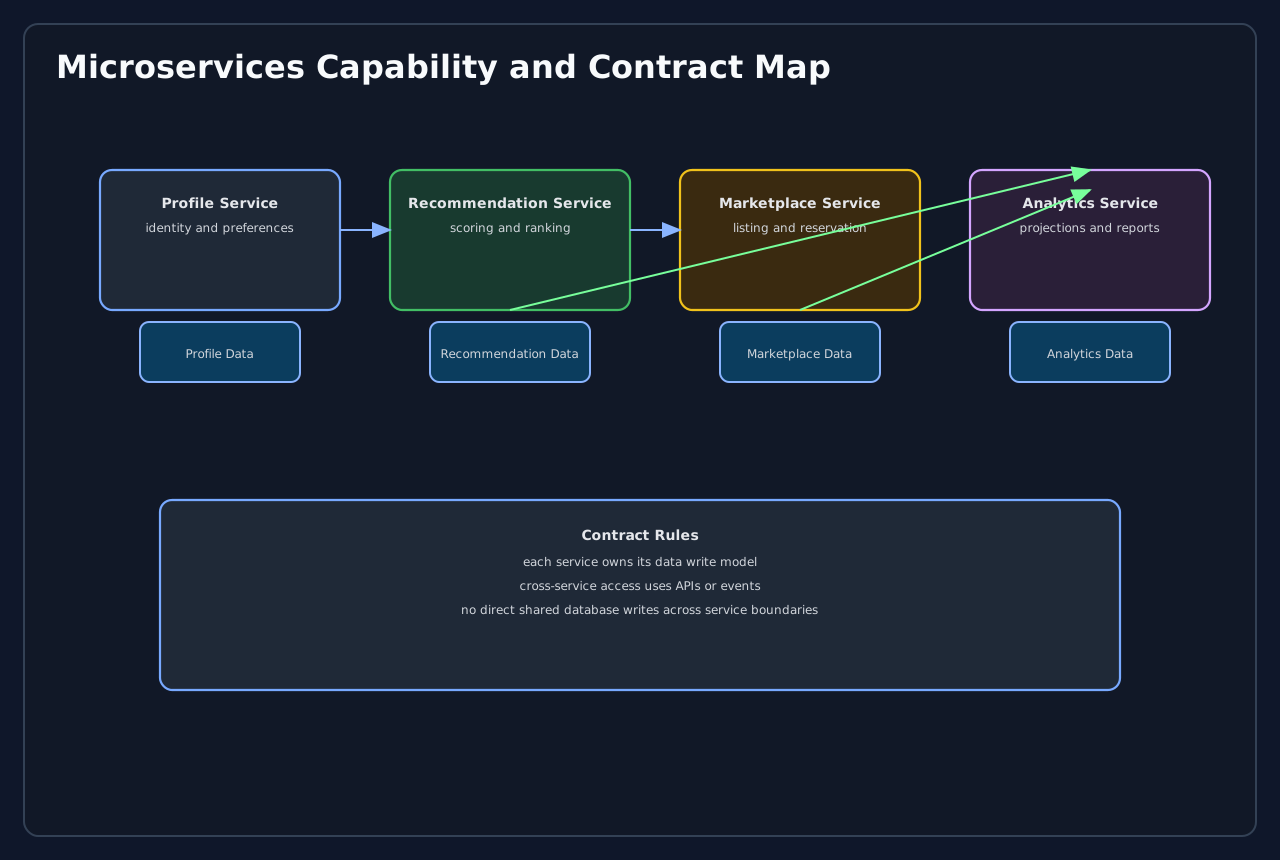
The diagram shows capability boundaries, data ownership, and contract channels.
Avoiding the Distributed Monolith
A distributed monolith appears when services are physically separate and logically inseparable. Symptoms include synchronous dependency chains, shared databases, coordinated releases, and cascading failure paths. Boundary quality and dependency control prevent this failure mode.
Decomposition as an Engineering Discipline
Service decomposition is not a one-time modeling session. It is a repeatable engineering process with evidence, scoring, and review gates. A strong decomposition program combines domain language, data semantics, operational telemetry, and team ownership constraints. The goal is stable boundaries with low change coupling and clear accountability.
How It Works
A practical adoption path:
Step 1. Start with domain mapping. Identify bounded contexts and high-volatility capability areas.
Step 2. Define service boundaries with clear ownership. Each boundary should have explicit API and event contracts.
Step 3. Define data ownership model. Each service owns its write model. Cross-service data needs use APIs, events, or projections.
Step 4. Define communication style per capability. Use REST, gRPC, event, and message channels by fit.
Step 5. Implement platform guardrails. Identity standards, tracing standards, retry policy, and release policy should be shared.
Step 6. Add contract and resilience tests. Each service validates compatibility and failure paths continuously.
Step 7. Add observability baselines. Track latency, error rate, queue lag, dependency failure rate, and saturation per service. For architecture-level implementation details, see Observability in Microservices.
Step 8. Apply progressive decomposition. Extract services in priority order from a strong modular base. Avoid uncontrolled parallel extraction.
Decomposition Methodologies
A high-quality decomposition program needs a repeatable workflow. This workflow combines domain analysis, data analysis, runtime analysis, and team analysis. No single technique can produce stable service boundaries alone.
Decomposition Workflow
Pass 1. Domain narrative mapping. Run event storming with product, domain, architecture, and delivery participants. Capture commands, events, policies, and invariants in one shared map. Mark hot areas where policy changes happen often.
Pass 2. Capability clustering. Group use cases by policy ownership, language consistency, and change cadence. Propose candidate service boundaries from these clusters. Reject clusters that mix unrelated business outcomes.
Pass 3. Transactional seam analysis. List invariants that require one commit decision. Locate transaction boundaries that can stay local to one service. Treat any boundary that splits one invariant set as high risk.
Pass 4. Change-coupling analysis. Mine commit history to detect modules that change together. Frequent co-change across two candidate services signals weak boundaries. Frequent co-change inside one candidate boundary signals cohesion.
Pass 5. Runtime topology analysis. Use distributed traces and dependency graphs. Measure synchronous fan-out depth, retry amplification, and p95 latency chains. Stop extraction when one candidate boundary creates deep call cascades.
Pass 6. Team and ownership analysis. Map each candidate service to one long-lived owner team. Score cognitive load, on-call scope, and skill coverage. Reject boundaries with unclear ownership or unstable staffing plans.
Decomposition Techniques in Detail
- Bounded-context decomposition
Use domain driven design strategic modeling to define boundaries where terms keep one meaning. A bounded context should contain one cohesive policy set. Boundary names should reflect business language used by domain experts.
- Context map modeling
Document upstream and downstream relationships between contexts. Mark conformist, customer-supplier, and partnership links. Plan anti-corruption layers where semantic translation cost is high.
- Event-storming session design
Run workshop sessions with timeline focus. Start from domain events, then commands, then policies. Capture unresolved conflicts and mark them as split risks. Repeat sessions each quarter for domains with rapid change.
- Transactional seam mapping
Model invariants before API design. One invariant cluster should map to one service write owner. Cross-service workflows should use saga or process manager patterns only after local transaction design is complete.
- Change-coupling mining
Use version-control mining tools to compute co-change frequency. Build a matrix where rows and columns are candidate boundaries. Strong off-diagonal co-change values indicate hidden coupling. Split decisions should use this evidence, not intuition alone.
- Runtime trace slicing
Capture end-to-end request traces for peak and normal traffic windows. Detect orchestration hotspots and high-fan-out request paths. Move orchestration logic to a single owner service when fan-out depth crosses accepted limits.
- Team-topology alignment
Apply stream-aligned ownership for domain services. Use platform teams for shared infrastructure capabilities. Use enabling teams for short-lived domain coaching and migration support. Apply reverse Conway planning when team structure blocks good boundaries.
- Security and policy boundary mapping
Map trust zones and data-classification zones before service extraction. Align service boundaries to policy enforcement boundaries. Avoid boundaries that force broad cross-service access grants.
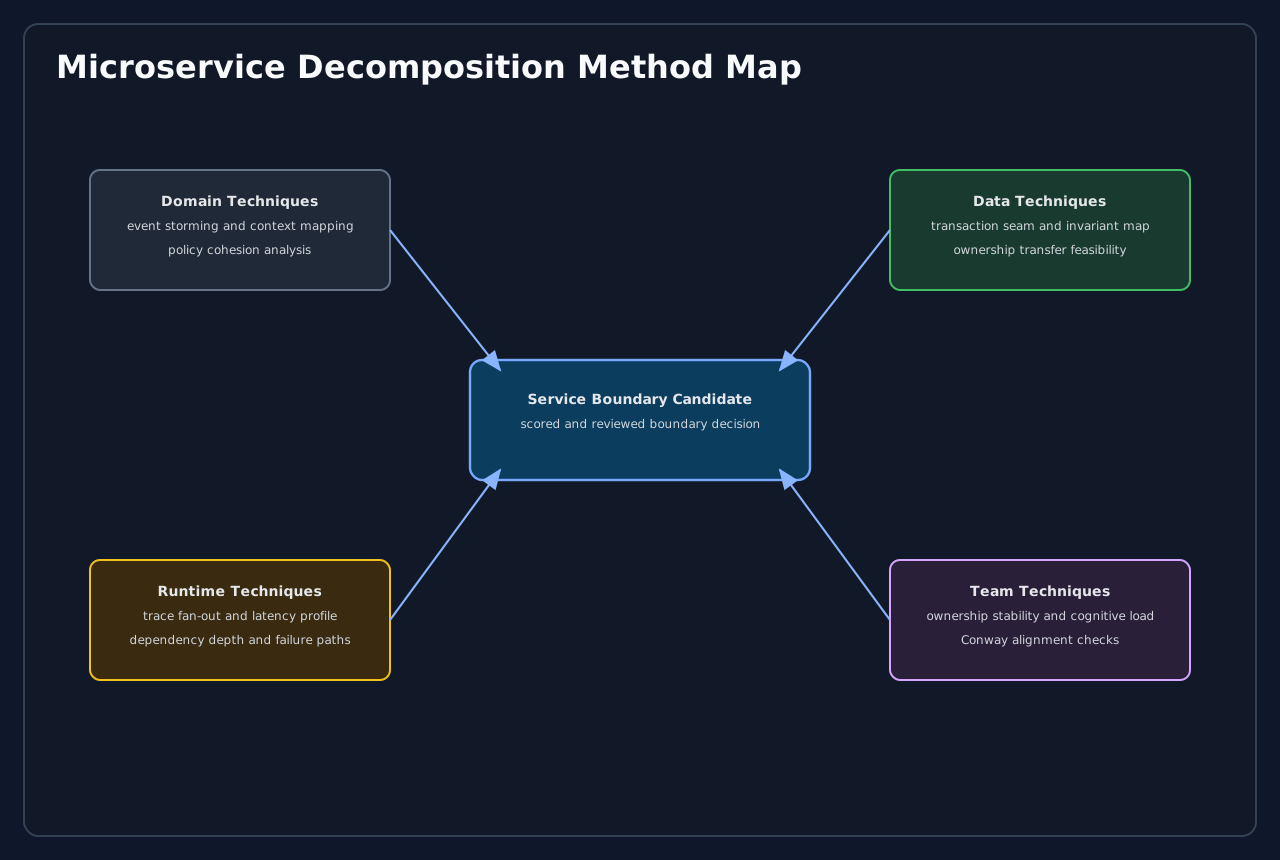
The diagram links domain, data, runtime, and team techniques used in decomposition reviews.
Extraction Techniques and Migration Tactics
After boundary selection, extraction needs controlled migration tactics.
- Strangler migration
Route selected capabilities from the monolith to the new service incrementally. Keep routing control at one edge layer. Move one capability slice at a time.
- Branch-by-abstraction
Introduce abstraction seams in the monolith first. Switch implementation targets behind stable interfaces. This allows service redirection with lower release risk.
- Shadow traffic and parallel run
Mirror production requests to the new service without user-visible response switching. Compare outcomes and latency distributions. Promote traffic only after equivalence thresholds pass.
- Contract-first rollout
Publish explicit service contracts before cutover. Run consumer-driven contract tests in CI for every change. Reject breaking changes without migration windows.
- Data migration by ownership transfer
Move write ownership first. Keep read compatibility through projections during transition. Use outbox and CDC pipelines for projection updates where needed.
- Risk-gated release policy
Use canary rollout with SLO guardrails. Track error rate, p95 latency, saturation, and retry amplification. Rollback on threshold breach with predefined runbooks.
Practical Decomposition Scorecard
A scorecard helps remove subjective boundary choices. Each candidate boundary can be scored on a 1 to 5 scale per criterion.
- domain cohesion
- transactional coupling
- change coupling
- runtime dependency depth
- team ownership clarity
- security boundary clarity
- observability readiness
A low score on transactional coupling or ownership clarity is a stop signal. The candidate should be redesigned before extraction.
Modern Methodologies for Decomposition Programs
Modern microservice initiatives use a combined methodology stack. Each method contributes one type of evidence.
- Domain-driven strategic design
Use subdomain classification to separate core, supporting, and generic capabilities. Prioritize extraction for core domains that have high change pressure. Keep supporting domains modular inside a modern monolith until extraction pressure is clear.
- Event storming plus architecture decision records
Use event storming outputs as boundary discovery input. Record boundary decisions with architecture decision records. Store rejected alternatives and tradeoff rationale in each record.
- Team Topologies planning model
Treat service decomposition as a socio-technical design task. Map candidate services to stream-aligned teams and platform capabilities. Track cognitive load each quarter. Merge services when load exceeds team capacity.
- Evolutionary architecture fitness functions
Define automated checks for dependency direction, forbidden imports, contract compatibility, and latency budgets. Run these checks in CI and release gates. Fail the pipeline when boundary rules are violated.
- Observability-driven boundary review
Create service scorecards from live telemetry. Review p95 latency, error budget burn, queue lag, and retry amplification per service. Use this data to tune boundaries after each extraction wave.
Modern Best Practices
Modern microservice programs keep a small set of repeatable practices.
- keep one service-to-domain ownership map and review it quarterly
- require architecture decision records for boundary changes
- require contract tests and compatibility checks for every interface
- require service runbooks before production cutover
- keep service count proportional to team maturity and platform maturity
- track decomposition outcomes with lead time, change failure rate, and MTTR
- perform post-extraction review after 30, 60, and 90 days
- reverse or merge boundaries that fail cohesion and ownership criteria
Boundary Anti-Patterns
The following anti-patterns signal poor decomposition quality.
- technical-layer services such as one shared data service used by many domains
- entity-per-service splits that ignore policy and workflow cohesion
- shared database tables with write access from many services
- forced synchronous chains for workflows that need asynchronous coordination
- extraction driven only by team politics with no domain evidence
- service count growth that exceeds platform and on-call capacity
Decomposition Strategy in the Scenario
A practical scenario split can follow this sequence:
- Keep one modern monolith with explicit modules.
- Extract recommendation service first when scaling and model cadence diverge.
- Extract marketplace service when reservation flow needs independent release and risk controls.
- Keep analytics read projections decoupled through event channels.
This path keeps delivery stable and reduces architecture shock.
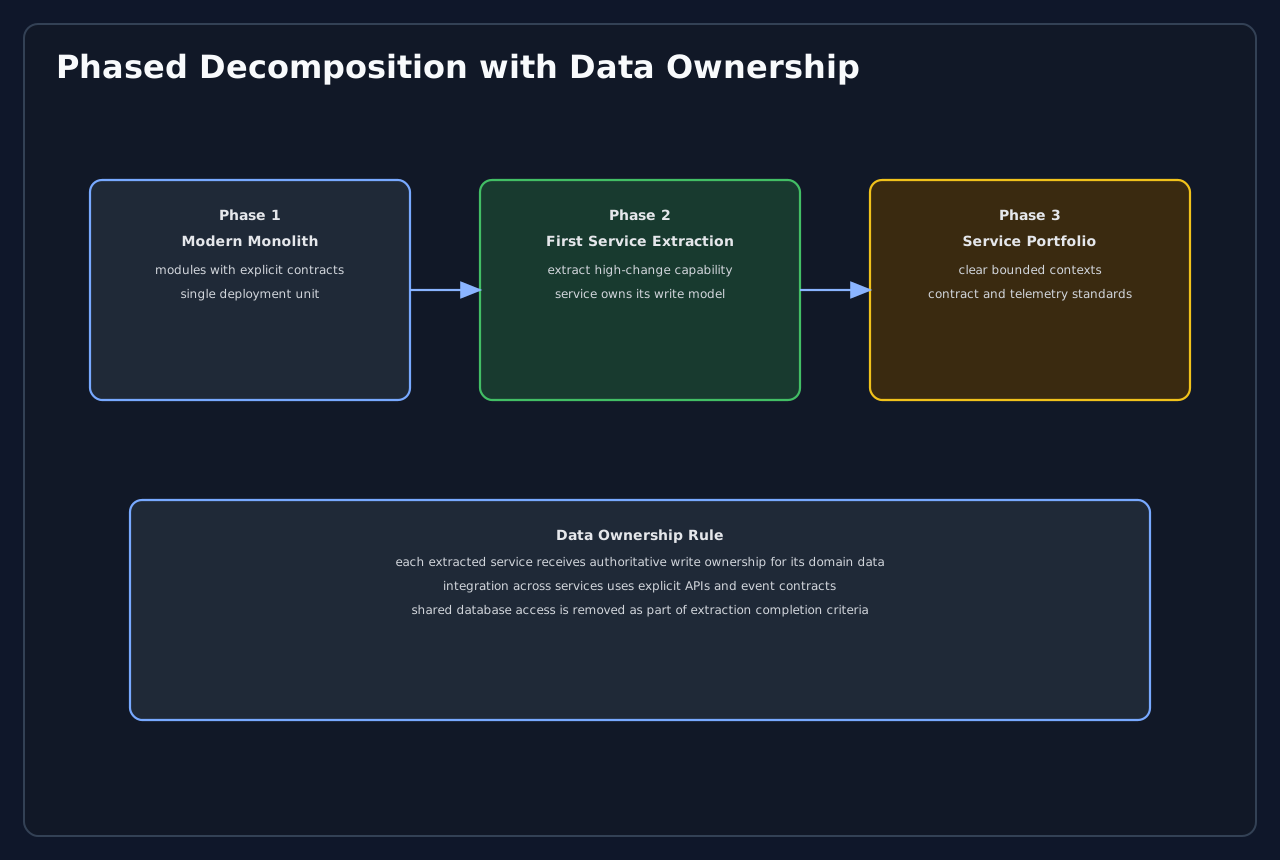
The diagram shows a phased split and service-owned data boundaries.
Challenges and Shortcomings
Microservices add strong benefits and significant cost. Teams should adopt the style only with clear business and technical drivers.
Common risks:
- unstable boundaries that cause constant contract churn
- high synchronous coupling that creates cascading failures
- weak operational maturity across many service teams
- duplicated logic across services from poor domain alignment
- excessive service fragmentation with low cohesion
The style can fail without platform investment. CI, observability, security, and incident response need strong standards. Service autonomy requires disciplined contract governance.
A small team with one product surface can lose speed with premature service decomposition. A modular monolith can be a stronger fit at that stage.
Link to Existing Handbook Concepts
| Concept | Why? |
|---|---|
| Modern Monolith Architecture | A modern monolith can be a strong first step before service extraction. |
| Hexagonal Architecture | Each microservice should keep internal ports and adapters. |
| Hexagonal with REST and gRPC in Microservices | That page details protocol strategy at service boundaries. |
| Service Interaction Style Selection Framework | Channel choice should follow capability profile. |
| The Database Dilemma | Service boundaries and data ownership shape transaction strategies. |
| Zero Trust Architecture | Service identity and policy enforcement are mandatory in distributed systems. |
Written by: Pedro Guzmán
See References for complete APA-style bibliographic entries used on this page.