GraphQL Constraints and Goals
Core Idea
Examples and diagrams in this page follow the shared Hypothetical Scenario.
GraphQL is a contract-first query and mutation style for distributed services. A GraphQL system exposes a typed schema that defines available operations and data shapes. Clients request precise fields through operation documents. Servers execute those requests through resolver functions over domain and data boundaries.
From an architecture view, GraphQL is not a direct replacement for every API style. It is a model with explicit constraints. Those constraints shape the quality profile of the platform. They can improve flexibility and product iteration speed. They can introduce runtime complexity and governance burden.
This page describes the main GraphQL architectural constraints and the quality goals they support.
Historical Context
GraphQL started at Facebook in 2012 and became public in 2015. The model addressed client over-fetching and under-fetching issues in mobile and web API usage. The GraphQL specification and ecosystem then expanded through open governance and tooling growth. Enterprise adoption brought schema governance, query cost control, and federation design practices.
Sources: Facebook Engineering (2015), GraphQL Foundation (2021), and Hartig and Pérez (2018)
The Problem It Solves
Traditional endpoint catalogs can fragment quickly. Each screen variant requests different data slices. Teams add many endpoint variants to match UI needs. The service surface grows and drifts. Client payload waste grows.
GraphQL addresses this issue through one typed contract surface. Clients specify data requirements at field level. Server exposes one schema with explicit operation and type definitions. The contract remains stable through additive schema evolution.
In the car platform this helps on flows such as recommendation brief screens. One screen needs cost details and reliability trend data. Another screen needs ownership projection and resale bands. GraphQL can serve both from one schema without endpoint sprawl.
Main Concept
GraphQL architecture revolves around a set of practical constraints.
Typed Schema Constraint
Every capability is defined in a typed schema. Types, fields, arguments, and nullability rules form the public contract. Schema quality drives consumer confidence and tooling quality.
Client Selection Constraint
Clients request exact fields through selection sets. This can reduce payload waste. This can create resolver fan-out risk if server execution rules are weak.
Operation Model Constraint
GraphQL operations are query, mutation, and subscription. Query reads data. Mutation changes state. Subscription streams state change updates. Each operation category needs explicit policy and execution controls.
Resolver Boundary Constraint
Resolvers map schema fields to domain execution logic. Resolver layering must respect service boundaries and data ownership. Resolver design can create N+1 query risks in poor execution models.
Complexity and Cost Constraint
GraphQL allows expressive nested selection trees. A platform must enforce depth, complexity score, and rate controls. Without these controls, one query can consume disproportionate resources.
Evolution Constraint
GraphQL favors additive schema evolution and field deprecation. Breaking field removal needs governance windows and consumer migration policy.
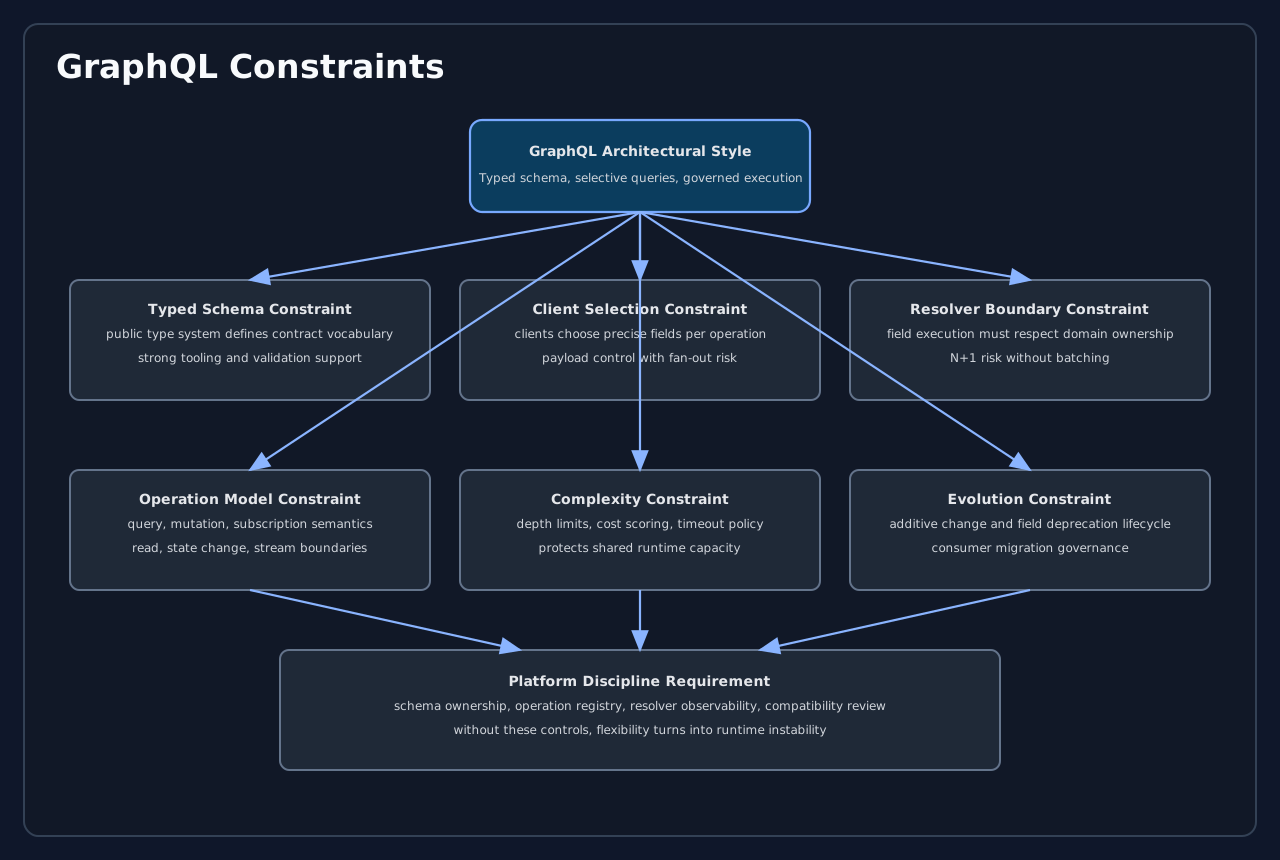
The diagram maps these constraints to runtime and governance impact.
Goals of the GraphQL Style
GraphQL constraints support a set of architecture goals.
Performance Precise field selection can reduce payload size and network transfer cost. Resolver efficiency and batching design remain critical for real gains.
Scalability Schema-driven APIs can serve diverse clients through one contract surface. Query cost controls and execution limits are required for stable scale behavior.
Simplicity One schema can reduce endpoint sprawl for consumers. Server internals can become complex if resolver governance is weak.
Modifiability Additive field evolution enables feature growth with lower break risk. Deprecation policy and schema review gates are required.
Visibility Typed schema and operation logs improve API inspection and change auditing. Field-level metrics can expose hot paths and costly query patterns.
Portability Strong schema tooling supports multi-client code generation and type-safe integration. Cross-team contract reuse improves with stable naming and semantic discipline.
Reliability Query validation, cost controls, timeout policy, and partial error handling support reliable behavior. Reliability depends on execution controls and resolver fault boundaries.
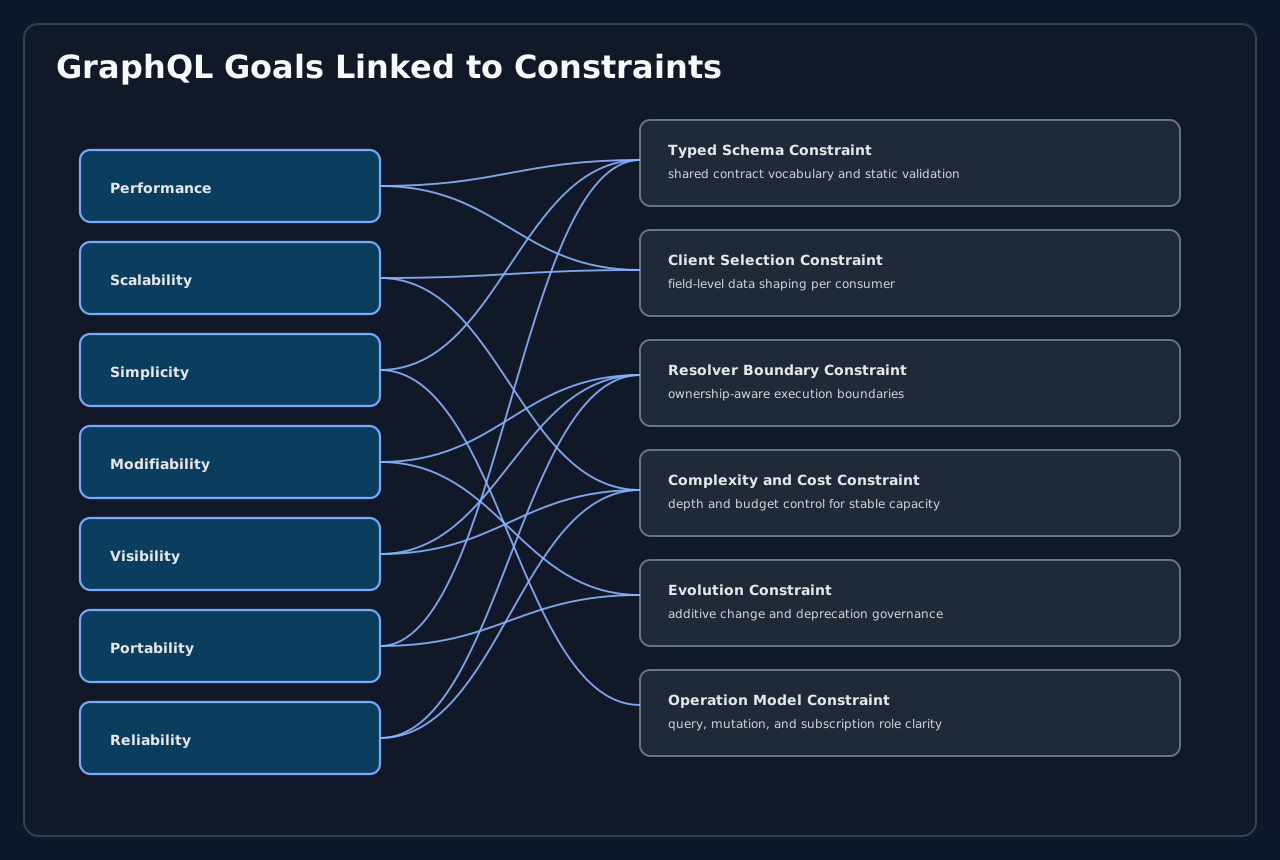
The diagram links each goal to high-impact GraphQL constraints.
How It Works
A practical implementation flow:
Step 1. Define bounded capability scopes in domain language.
Step 2. Design schema with explicit type ownership and nullability semantics.
Step 3. Map each field to resolver boundaries that respect service ownership.
Step 4. Add batching and caching strategies for high-frequency field paths.
Step 5. Add query complexity controls and depth limits.
Step 6. Add operation tracing with field-level timing and error metrics.
Step 7. Add schema governance for additive changes and deprecation windows.
Step 8. Validate through load tests, contract tests, and migration tests.
A decision table can support architecture review.
| Decision Lens | Strong Fit for GraphQL | Risk Area |
|---|---|---|
| Heterogeneous client data needs | Strong | - |
| Rapid UI iteration with varied projections | Strong | - |
| Simple fixed payload command APIs | Mixed | Over-complexity risk |
| Deep nested object graphs | Mixed | Resolver fan-out and cost risk |
| Strict operation-level throughput control | Mixed | Query cost governance required |
Challenges and Shortcomings
GraphQL can centralize contract clarity and still create runtime complexity. Resolver fan-out can increase data source load. Team discipline is required for schema naming and ownership.
Common failure modes:
- schema growth with weak capability boundaries
- resolver access that bypasses domain policy boundaries
- missing complexity controls under public traffic
- weak deprecation governance and stale consumer usage
GraphQL is a strong fit for rich read models with varied client views. GraphQL is a weaker fit for narrow command-only APIs with strict fixed contracts. Architecture teams should choose GraphQL where its constraint model aligns with problem shape.
Link to Existing Handbook Concepts
| Concept | Why? |
|---|---|
| Introduction to Services | Schema types and operations represent service capabilities in a typed contract model. |
| Service Contracts with REST | Both styles need explicit contract governance and compatibility discipline. |
| Interaction Style Selection Framework | GraphQL fit should be decided against capability shape and governance maturity. |
| Hexagonal Architecture | Resolvers act as inbound adapters over driving ports and core capability logic. |
| Abstraction and Boundaries | Schema design defines boundary abstractions for consumers. |
| Correctness and Testing | Contract tests must verify schema validity, resolver semantics, and cost control behavior. |
Written by: Pedro Guzmán
See References for complete APA-style bibliographic entries used on this page.