Message-Driven Architecture
Core Idea
Examples and diagrams in this page follow the shared Hypothetical Scenario.
Message-Driven architecture is a service interaction style where one party sends a message that asks for work, and another party handles that work through a message channel. The message is task-centered. The sender expects work execution. The receiver owns execution logic and produces an outcome message or side effect.
This style is close to Event-Driven messaging, yet the intent is different. Event-Driven flows publish facts about state that already changed. Message-Driven flows send requests for work that must be performed. That distinction changes ownership, routing rules, and error handling policy.
This page defines Message-Driven architecture from a service orientation view. It explains where this style fits, where it does not fit, and how to combine it with Event-Driven flows in one platform.
Historical Context
Enterprise messaging systems in the 1990s and 2000s used queues for command-style work distribution. Hohpe and Woolf documented message channel and consumer patterns that shaped modern asynchronous design. Service-oriented practice later used these patterns in large integration programs. Cloud messaging platforms then expanded these ideas with managed queues, retries, and dead-letter controls.
Sources: Hohpe and Woolf (2003), Erl et al. (2012), and Kleppmann (2017)
The Problem It Solves
Synchronous request chains can fail under load spikes and partner instability. One API call can wait for many downstream calls. A single slow dependency can block user flow.
Event-Driven designs solve many notification and propagation flows. Yet some workflows are not notification flows. Some workflows are direct work requests. A listing image processing task is one example. A vehicle history fetch task is another. A fraud review scoring task is another.
These workflows need work dispatch with clear ownership and retry control. Message-Driven architecture solves that problem. The sender posts a work message. A worker service consumes it when capacity is available. Queue semantics absorb spikes. Back-pressure stays explicit.
Main Concept
Message-Driven architecture has four core elements.
- command or task message
- message channel or queue
- worker or consumer service
- outcome contract and failure policy
A command message expresses requested work. It carries intent, identifiers, constraints, and correlation metadata. A queue stores the message until a worker processes it. Workers consume messages through controlled concurrency. Outcome can be a response message, an event, or a state mutation.
Message-Driven versus Event-Driven
The distinction is easiest in contract intent.
| Aspect | Message-Driven | Event-Driven |
|---|---|---|
| Contract intent | Request work | Announce fact |
| Ownership signal | Sender asks receiver to act | Producer reports completed state change |
| Coupling shape | Stronger coupling to work semantics | Looser coupling to fact semantics |
| Typical channel | Queue with work distribution | Topic or stream with fan-out |
| Retry focus | Task completion guarantee | Consumer state convergence |
| Common fit | background processing, workflow commands | projections, notifications, analytics reactions |
In the car platform, GenerateRecommendationBrief is a Message-Driven command.
RecommendationBriefGenerated is an Event-Driven fact.
The command asks for execution.
The event reports completion.
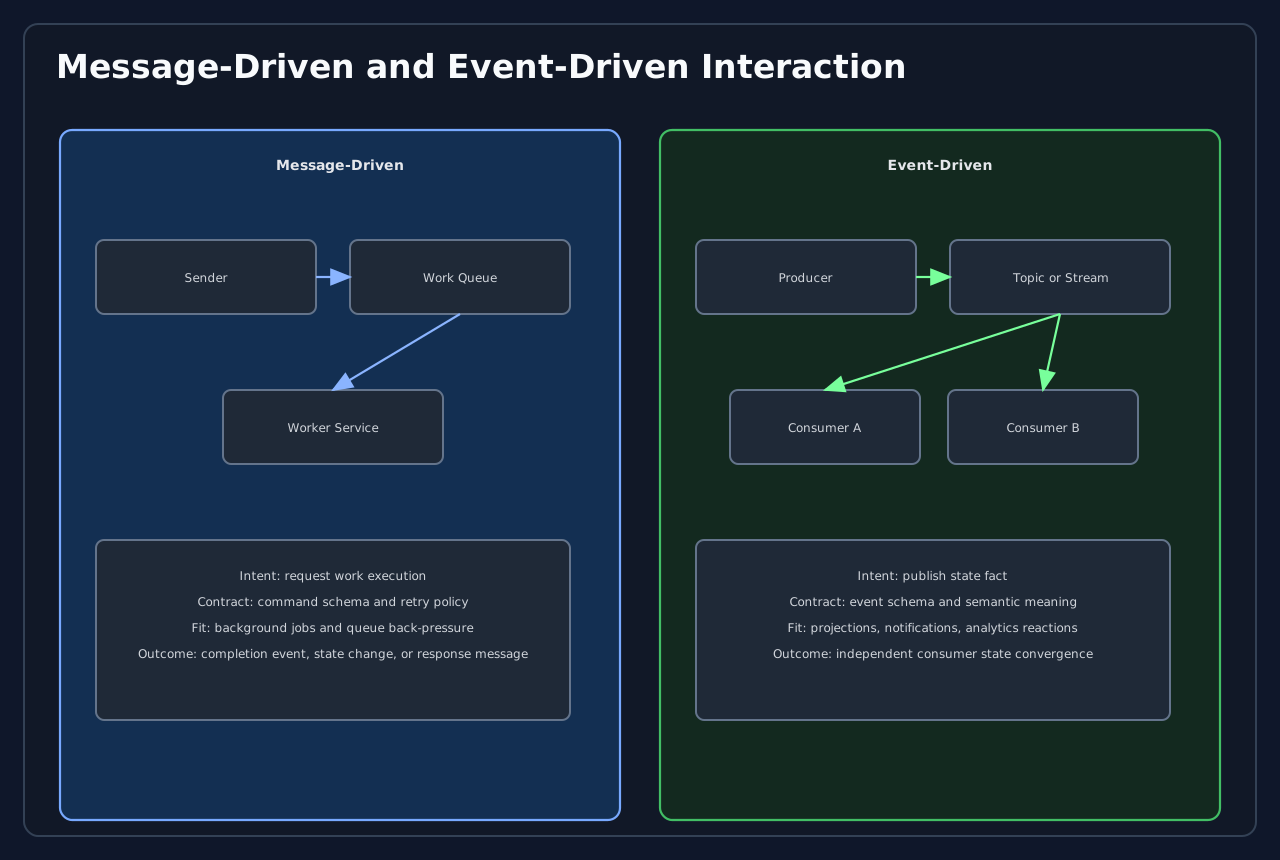
This diagram compares contract intent, channel behavior, and consumer expectation.
Where Message-Driven Fits
Message-Driven style fits these operation classes.
- long-running background jobs
- controlled work distribution to worker pools
- flows with queue-based back-pressure needs
- external integration tasks with retry policy
- workflows that need explicit command audit trail
This style has weak fit for real-time query calls that need direct response in tight latency budgets. That case often fits synchronous API contracts.
Architectural Constraints
Message-Driven systems operate under hard constraints.
-
Delivery semantics are never free of edge cases. At-least-once delivery creates duplicate risk. At-most-once delivery creates loss risk.
-
Ordering scope is limited. Global ordering is expensive at scale. Ordering is often key-based or partition-based.
-
Consumer idempotency is mandatory. Duplicate delivery and replay happen in production. Handlers must produce stable outcomes on repeat input.
-
Dead-letter policy must exist. Poison messages need isolation and operator workflows.
-
Observability metadata must travel with each message. Trace ID and correlation ID are part of contract quality.
Patterns in Message-Driven Design
Common patterns:
- Competing Consumers for parallel work handling
- Work Queue for task distribution
- Dead Letter Queue for poison isolation
- Retry with bounded backoff
- Inbox or dedup store for idempotent processing
- Command Message with explicit intent schema
- Process Manager for multi-step command workflows
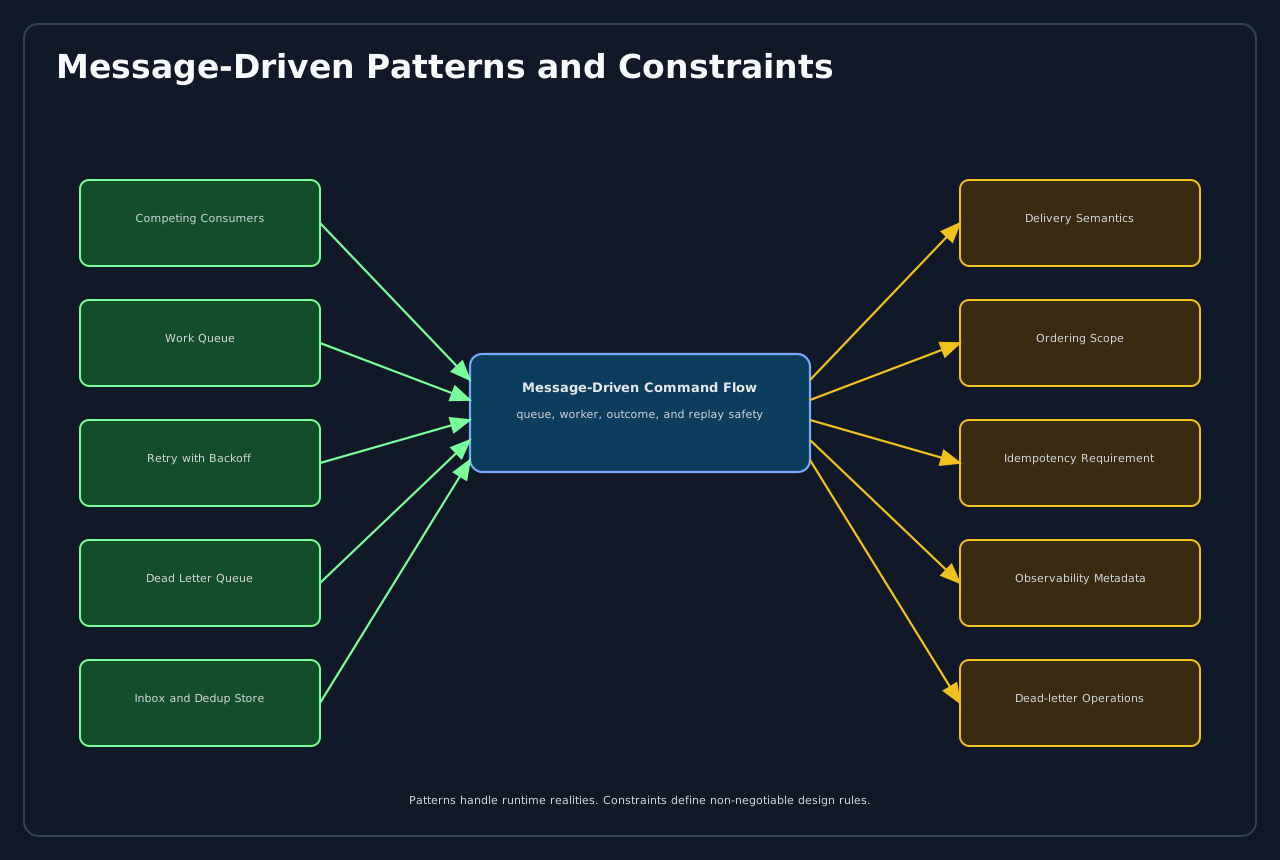
The diagram maps core patterns to reliability and scaling constraints.
How It Works
A practical architecture workflow:
Step 1. Classify each use case as command, query, or fact publication. Use Message-Driven contracts for command workflows with asynchronous execution needs.
Step 2. Define command contract schema. Include command ID, actor, aggregate ID, timestamp, correlation ID, and version.
Step 3. Define queue and worker topology. Set partition key, concurrency limits, and retry limits.
Step 4. Define idempotency strategy. Store processed command IDs or business operation keys.
Step 5. Define failure path. Route irrecoverable messages to dead-letter queue. Define operator runbook for triage and replay.
Step 6. Define outcome emission. Emit completion event or status message after local commit.
Step 7. Define monitoring model. Track queue depth, consumer lag, retry count, dead-letter volume, and processing latency.
Step 8. Validate with load and chaos tests. Test duplicate delivery, out-of-order handling, and worker crash recovery.
A command flow in the car platform:
- API layer sends
GenerateRecommendationBriefcommand. - Queue stores message with correlation metadata.
- Recommendation worker consumes and computes result.
- Worker stores result in local read model.
- Worker emits
RecommendationBriefGeneratedevent. - Notification service consumes event and sends user update.
This hybrid design uses Message-Driven for work request and Event-Driven for fact propagation.
Challenges and Shortcomings
Message-Driven systems can drift into hidden operational complexity. Queue depth can grow during external outages. Retry storms can amplify upstream instability. Dead-letter queues can become silent failure sinks if not monitored.
Command schema drift can break workers across deployments. Version governance is mandatory. Replay policy can conflict with mutable external side effects. Compensation or manual remediation paths are needed for non-idempotent external actions.
Architecture tradeoffs are clear. Message-Driven style improves decoupling and throughput under burst load. It increases observability and governance burden. Teams need mature runtime operations and contract discipline.
Link to Existing Handbook Concepts
| Concept | Why? |
|---|---|
| Event-Driven Messaging | Message-Driven and Event-Driven styles can coexist in one workflow. Commands request work. Events publish facts. |
| Interaction Style Selection Framework | Message channels should be selected for command execution with queue-based control. |
| Service Contracts with REST | Synchronous contracts often initiate asynchronous command flows. |
| The Database Dilemma | Durability needs and transaction semantics guide queue and outbox design. |
| Resilience and Recovery | Retry, dead-letter handling, and replay policy are resilience controls. |
| Correctness and Testing | Idempotency tests and duplicate-delivery tests validate message handler correctness. |
Written by: Pedro Guzmán
See References for complete APA-style bibliographic entries used on this page.