Introduction to Services
Core Idea
Examples and diagrams in this page follow the shared Hypothetical Scenario.
Service orientation starts with a simple design move. A software program exposes useful behavior through a published technical interface. That interface is a service contract. Clients call the contract, not private implementation details.
This model gives stable integration boundaries. Each service can evolve internally. Consumers stay stable when contract rules stay stable. A team can compose many services to automate larger tasks.
This page introduces core service terms and the architecture meaning behind them. It then links service thinking to Hexagonal Architecture.
Historical Context
Early distributed systems used RPC and object middleware to expose remote functions. Web services then standardized contract-first integration through SOAP and WSDL in the 2000s. Service-Oriented Architecture became a mainstream enterprise style during that period. In parallel, Amazon adopted an internal service mandate around 2002, later described publicly by former engineers. That mandate pushed teams to expose functionality through service interfaces and interact through those interfaces only.
Sources: Erl et al. (2012), Yegge (2011), and Stone (2013)
Service-Oriented Computing is the broader discipline. It studies how distributed software capabilities can be exposed, discovered, composed, and governed as services. Service-Oriented Architecture is one architecture style within that discipline. SOA applies service orientation principles to enterprise system design.
The Problem It Solves
Large systems fail through hidden coupling. One module reads another module database directly. Another module links to internal classes across team boundaries. Then one local change spreads across many applications.
Service orientation addresses this failure mode. It draws a public boundary for every exposed capability. The boundary is explicit in the contract. Consumers use the boundary through network calls or message exchange. Internal implementation stays private to the owning service.
The model solves three recurring problems.
- integration chaos from ad hoc direct dependencies
- weak ownership boundaries across teams
- low reuse of stable business capabilities
Main Concept
The core terms are direct and practical.
- Service: a software program that makes functionality available through a published service contract.
- Service contract: the technical agreement that defines operations, message format, error shape, policy, and version rules.
- Service capability: one function offered by the service through its contract.
- Service consumer: the runtime role assumed by a program that invokes and interacts with a service.
- Service agent: an intermediary runtime component that routes, transforms, secures, or governs service interaction.
- Service composition: an aggregate of services composed to automate a shared task.
This definition set creates clear roles. A service publishes capabilities. A consumer invokes capabilities. An agent can mediate interaction policy. A composition coordinates many capabilities to complete a process.
In the car platform scenario, one composition can generate a buyer recommendation brief. That composition can call profile service, market listing service, reliability analytics service, and ownership cost service. Each service owns a focused capability set. The composition orchestrates the sequence.
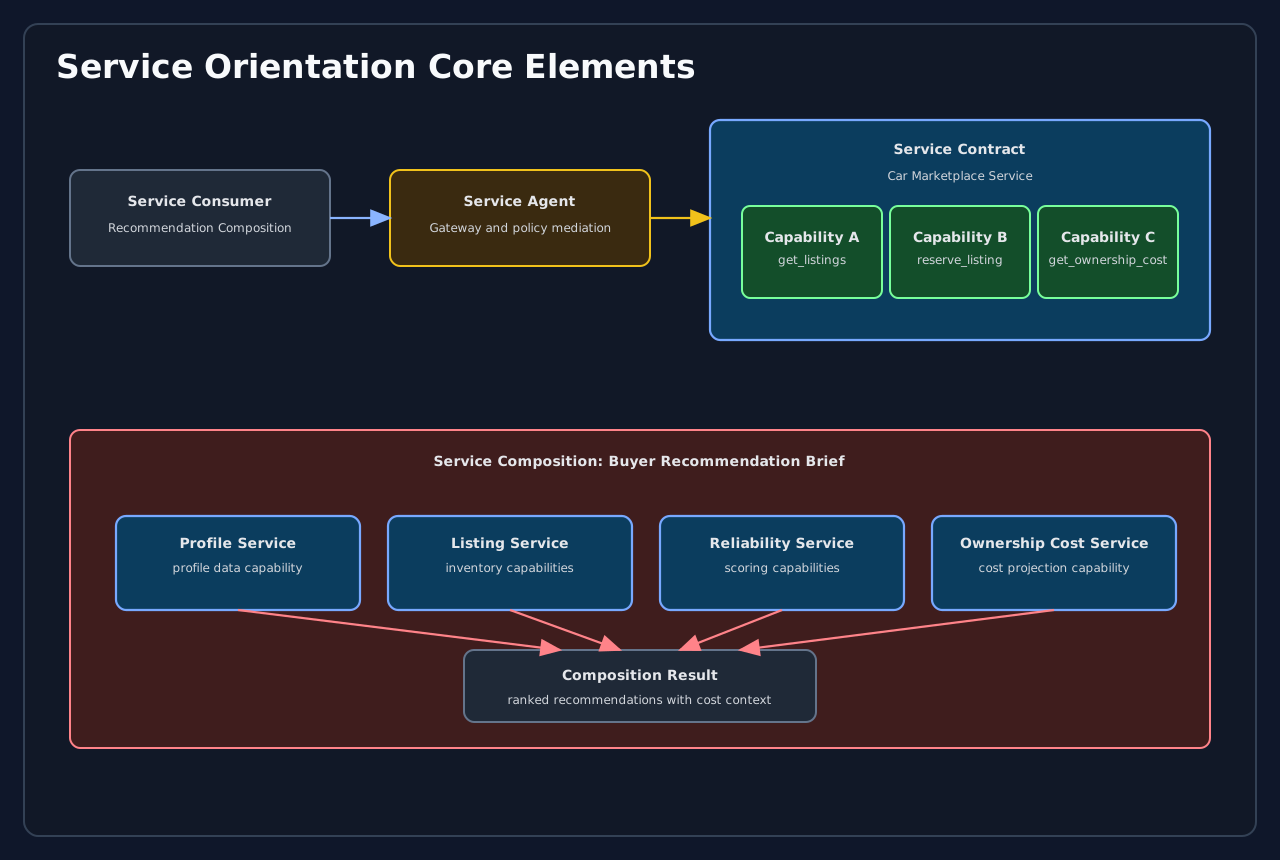
This diagram shows service contract, capabilities, consumer role, agent role, and composition flow.
How It Works
A service contract can be viewed in layers.
- capability layer with operation names and expected outcomes
- data layer with request and response schemas
- policy layer with authentication, authorization, rate controls, and version rules
- fault layer with error codes and retry guidance
A service consumer interacts through these layers. The consumer should not rely on private tables, private classes, or private deployment details. That separation gives stronger boundary stability.
Service composition can be simple or complex. A simple composition calls two services in sequence. A complex composition can include parallel calls, compensation logic, timeout rules, and fallback paths. Composition is not only orchestration code. It is contract alignment across participants.
A service agent appears when policy or mediation is needed. Common agent responsibilities include:
- protocol translation between internal and partner contracts
- token validation and policy enforcement
- request routing and throttling
- schema transformation and version mediation
Service orientation works best with explicit ownership. Each service needs a clear owner team and a clear capability boundary. Without ownership clarity, service boundaries degrade into shared monolith fragments.
Challenges and Shortcomings
Service orientation can fail under weak governance. Too many coarse services can recreate a distributed monolith. Too many tiny services can create network complexity and high operational cost.
Common risks:
- capability boundaries that follow org chart politics instead of domain language
- contract drift without version governance
- chatty compositions that increase latency and failure surface
- weak observability across service call chains
Architecture teams need explicit guardrails. Define capability granularity rules. Define contract review process. Define ownership and lifecycle policy for each service.
Link to Existing Handbook Concepts
| Concept | Why? |
|---|---|
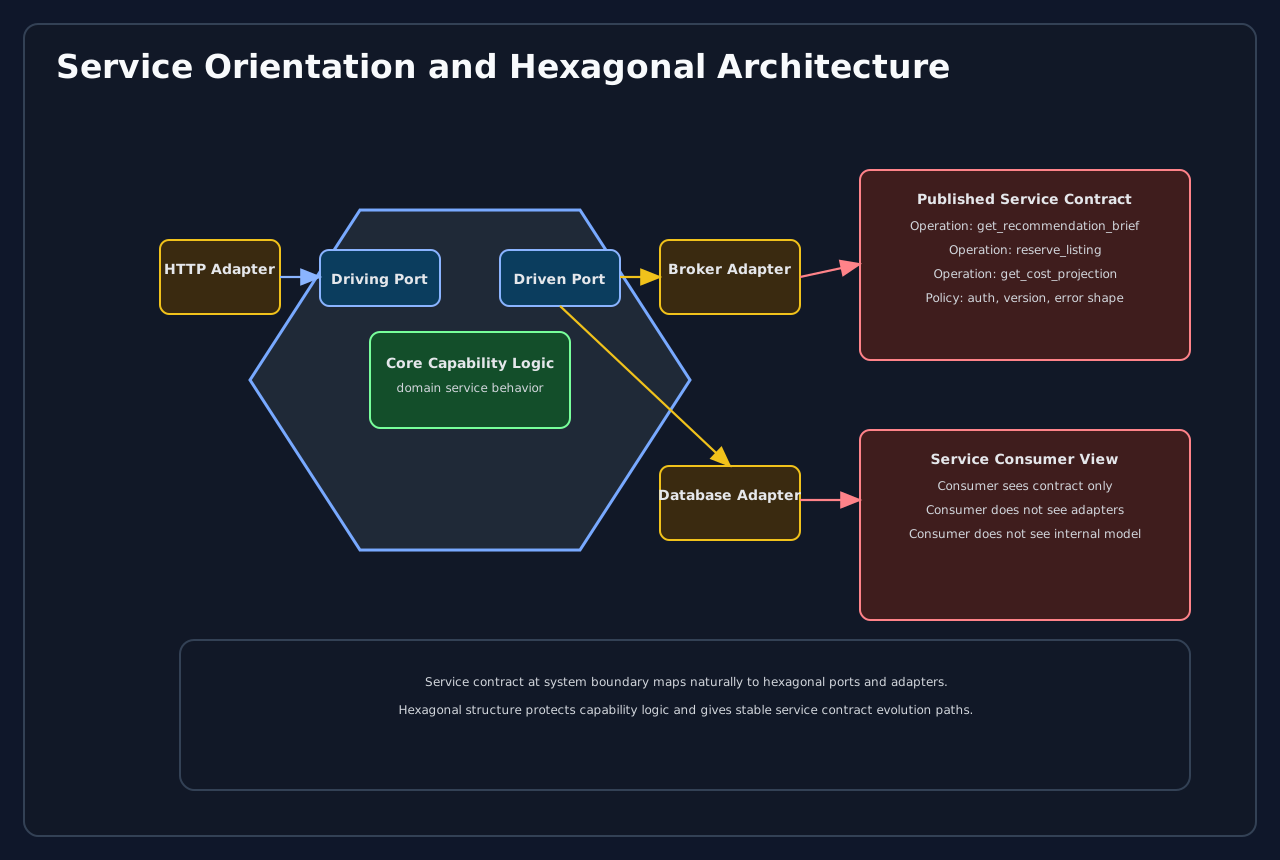
| Hexagonal Architecture | Service orientation aligns with Hexagonal Architecture. A service contract acts like a port at system boundary. Inbound and outbound adapters implement transport and protocol details. Core capability logic remains isolated from edge mechanics. |
| Onion Architecture | Service orientation aligns with Onion Architecture. Service capabilities belong to inner business layers. External protocol and persistence concerns stay in outer layers. |
| Abstraction and Boundaries | Service orientation aligns with Abstraction and Boundaries. A service contract is a boundary abstraction. Service consumers should depend on that abstraction only. |
| Modularity and Composition | Service orientation aligns with Modularity and Composition. Service composition automates higher-level workflows through focused modules. |
| Interaction Style Selection Framework | Service orientation links to Interaction Style Selection Framework. That page defines how to choose REST, GraphQL, gRPC, event, and message channels by capability profile. |
| Service contracts and hexagonal boundaries | !Service contracts and hexagonal boundaries |
Written by: Pedro Guzmán
See References for complete APA-style bibliographic entries used on this page.