Service Interaction Style Selection Framework
Core Idea
Examples and diagrams in this page follow the shared Hypothetical Scenario.
Service architecture fails fast when interaction styles are chosen from habit instead of system semantics. One team picks REST for everything. Another team adopts GraphQL for every endpoint. A third team uses gRPC for all internal and external calls. Messaging is added later as a patch for scale pain. This pattern creates contract inconsistency, unclear ownership, and avoidable migration cost.
A strong architecture program chooses interaction style per capability profile. The capability profile should include transactional requirements, query shape variability, latency targets, consumer diversity, and failure handling needs. Style choice is then a design decision with explicit trade-offs. It is not a framework preference.
This page defines a decision framework that unifies REST, GraphQL, gRPC, Event-Driven messaging, and Message-Driven messaging. The goal is coherence across the handbook and coherence in real systems.
Historical Context
The web API ecosystem adopted REST constraints after Fielding formalized the style in 2000. Typed API contracts gained momentum with GraphQL public release in 2015. gRPC introduced a modern contract-first RPC stack in the same period. Enterprise integration patterns had already framed asynchronous messaging discipline years earlier. Modern architecture now combines these styles inside one system with clear boundary rules.
Sources: Fielding (2000), Hohpe and Woolf (2003), Facebook Engineering (2015), and Google Open Source (2015)
The Problem It Solves
Most platform failures in API strategy come from style sprawl with no decision policy. The same business capability appears in multiple inconsistent interfaces. Contract semantics diverge by team. Observability patterns diverge. Error handling diverges. Testing scope diverges.
In the scenario platform, profile creation, recommendation generation, listing retrieval, reservation intent, and notification workflows each have different interaction demands. A single style cannot serve all demands with equal quality.
Examples:
- Recommendation detail views need flexible projection and nested data retrieval.
- Reservation commands need strict consistency semantics and idempotent retries.
- Internal scoring fan-out paths need low-latency typed calls.
- Notification and analytics reactions need asynchronous decoupling.
A decision framework solves this by mapping capability shape to interaction style characteristics. The framework avoids architecture drift and preserves conceptual consistency.
Main Concept
Decision Dimensions
The framework evaluates each capability through eight dimensions.
-
Contract shape stability Are request and response structures fixed, or do consumers need projection flexibility?
-
Consumer diversity How many client types consume this capability? Web only, mobile plus web, external partner APIs, or service-to-service only?
-
Latency objective Is the capability interactive in user flow, or asynchronous with relaxed completion timing?
-
Transaction semantics Does the operation require strict write consistency, idempotent command behavior, or eventual convergence?
-
Failure handling model Should failure return immediate caller feedback, deferred status updates, or compensating workflows?
-
Throughput profile Is traffic bursty, steady, or fan-out intensive?
-
Evolution pressure Does the contract change frequently with product iteration?
-
Governance maturity Can the team sustain schema review, compatibility checks, and runtime policy gates?
These dimensions generate a structured choice, not an opinion.
Style Profiles
REST profile: Best for resource-oriented public contracts, broad ecosystem compatibility, and cache-friendly read operations. Weak fit for highly variable projection-heavy read models with large endpoint variant pressure.
GraphQL profile: Best for high-variance read projections across many consumers. Weak fit for unmanaged query cost environments or narrowly scoped command-only capabilities.
gRPC profile: Best for internal low-latency service-to-service calls with strict typed contracts. Weak fit for broad browser-native public API exposure.
Event-Driven profile: Best for fact propagation, independent projections, and asynchronous decoupling. Weak fit for direct command intent that needs explicit execution ownership.
Message-Driven profile: Best for asynchronous command execution with queue back-pressure and retry control. Weak fit for immediate response requirements with tight user-facing latency budgets.
Composite Architecture Rule
Large systems should not seek one universal style. They should define composition rules. A common and reliable composition in the scenario:
- external read APIs: REST or GraphQL by projection variability
- external write APIs: REST with idempotency policy and explicit command semantics
- internal synchronous calls: gRPC for low-latency typed service interactions
- asynchronous propagation: Event-Driven contracts
- asynchronous work dispatch: Message-Driven contracts
This composition creates a clean separation of intent. Read flexibility, command reliability, and asynchronous decoupling each get a suitable mechanism.
Selection Matrix
| Capability Trait | REST | GraphQL | gRPC | Event-Driven | Message-Driven |
|---|---|---|---|---|---|
| Public internet compatibility | High | Medium | Low | Medium | Medium |
| Projection flexibility | Medium | High | Low | Low | Low |
| Typed strictness | Medium | High | High | Medium | Medium |
| Internal low-latency calls | Medium | Medium | High | Low | Low |
| Async fact propagation | Low | Low | Low | High | Medium |
| Async command execution | Low | Low | Medium | Medium | High |
| Contract governance burden | Medium | High | High | High | High |
The matrix is not a scorecard for winners. It is a map of fit by capability shape.
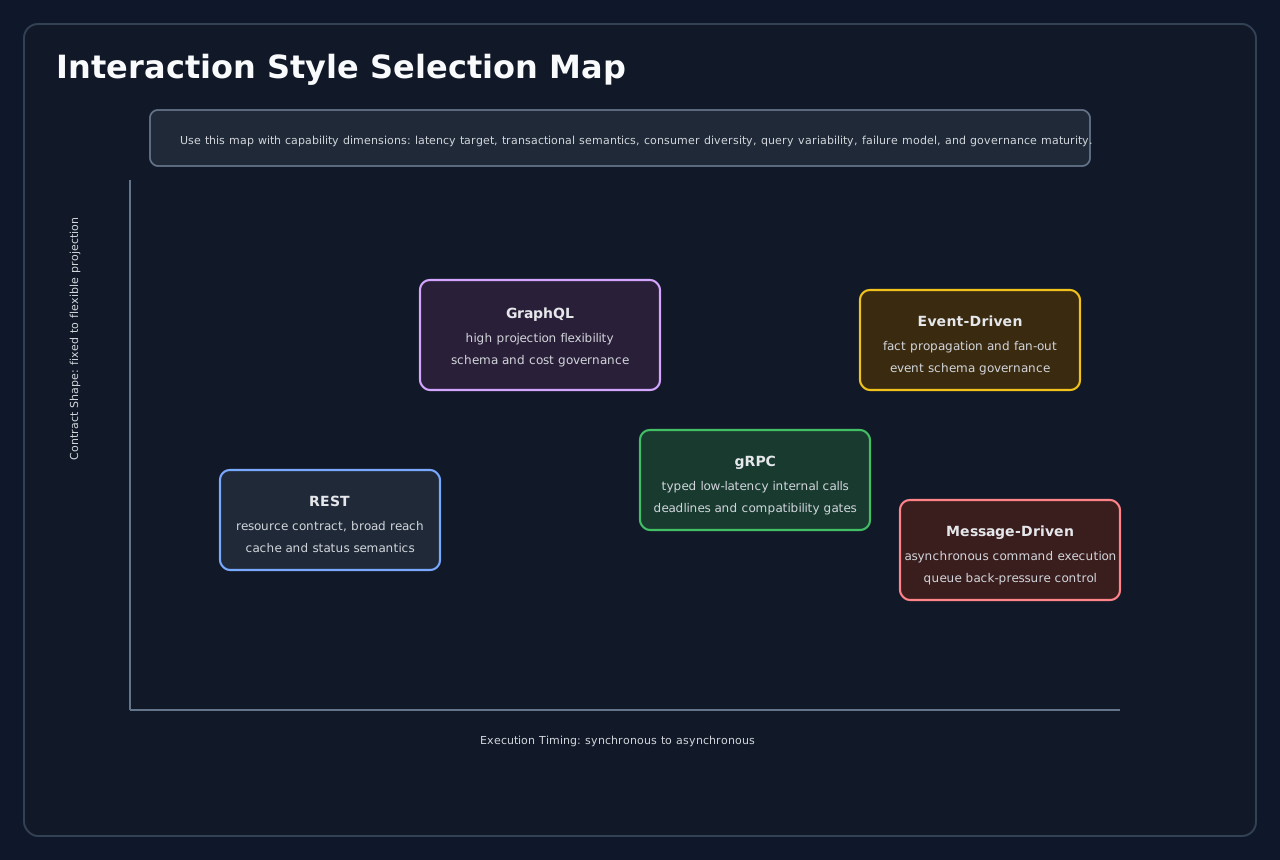
The map places each style by contract shape, execution timing, and governance controls.
How It Works
A practical process for architecture teams:
Step 1. Capability inventory. List capabilities in business language. Do not start from endpoints or transport.
Step 2. Capability classification. Tag each capability as read model, command, fact publication, or background task.
Step 3. Dimension scoring. Score each capability on the eight decision dimensions. Use explicit values and rationale.
Step 4. Candidate style mapping. Map each capability to one or two candidate styles. If two styles are viable, record the trade-off with measurable impact.
Step 5. Boundary design. Define port contracts in core architecture. Keep transport details in adapters. This preserves optionality and aligns with Onion and Hexagonal models.
Step 6. Governance policy definition. Define style-specific controls. Examples:
- REST: status semantics, cache policy, version rules
- GraphQL: schema review, complexity budgets, deprecation windows
- gRPC: protobuf compatibility checks, deadline defaults, status mapping
- Event-Driven: schema version policy, idempotent consumer rules
- Message-Driven: retry limits, dead-letter policy, command dedup keys
Step 7. Testing strategy alignment. Define contract tests, compatibility tests, and failure-mode tests per style. Integrate these tests into release gates.
Step 8. Runtime observability alignment. Define metrics and traces per style and capability. Correlate them through shared IDs.
Step 9. Periodic architecture review. Re-evaluate style decisions as capability demand changes. Do not freeze design forever. Do not drift without review.
Applied to the scenario:
- vehicle listing browse APIs with stable resources and caching use REST
- recommendation query surface with variable projections uses GraphQL
- scoring service fan-out uses gRPC
- recommendation completion and marketplace state updates publish events
- heavy background enrichment jobs run through message queues
This model gives coherence and preserves focused intent per channel.
Challenges and Shortcomings
A framework does not remove complexity. It makes complexity explicit. That still requires operational discipline.
Common challenges:
- teams treat style choice as immutable and skip periodic review
- governance controls are defined and not enforced
- one capability leaks across channels with conflicting semantics
- style ownership is unclear and no team maintains contract health
- observability taxonomies differ across channels and block root-cause analysis
There is a trade-off between local team speed and platform coherence. Strict governance can slow short-term delivery. No governance creates long-term migration and incident cost. Architecture leadership should set the balance through measurable policy.
Link to Existing Handbook Concepts
| Concept | Why? |
|---|---|
| REST Constraints and Goals | REST remains a core option for resource contracts and broad compatibility. |
| GraphQL Constraints and Goals | Service Contracts with GraphQL. GraphQL fits high-variance read surfaces with strong schema governance. |
| Service Contracts with GraphQL | Service Contracts with GraphQL. GraphQL fits high-variance read surfaces with strong schema governance. |
| gRPC Constraints and Goals | Service Contracts with gRPC. gRPC fits typed internal low-latency capability calls. |
| Service Contracts with gRPC | Service Contracts with gRPC. gRPC fits typed internal low-latency capability calls. |
| Event-Driven Messaging | Message-Driven Architecture. Asynchronous styles should be chosen by intent. Facts and commands need different contracts. |
| Message-Driven Architecture | Message-Driven Architecture. Asynchronous styles should be chosen by intent. Facts and commands need different contracts. |
| Onion and Hexagonal Together | Interaction style selection belongs at adapter boundaries. Core policies should stay style-agnostic. |
| The Database Dilemma | Transaction semantics constrain interaction style choices for write paths. |
Written by: Pedro Guzmán
See References for complete APA-style bibliographic entries used on this page.