Zero Trust Architecture
Core Idea
Examples and diagrams in this page follow the shared Hypothetical Scenario.
Zero Trust Architecture is a security architecture pattern where no actor, network segment, service, or device is trusted by default. Every access request is evaluated against policy and context. Authorization is explicit, scoped, and time-bound. Validation is continuous across the full request lifecycle.
This pattern changes one old assumption. A request coming from an internal network location does not receive automatic trust. Identity claims, device posture, workload identity, request context, and policy state all participate in each decision.
For the handbook scenario, this matters across user profile flows, recommendation services, marketplace APIs, and internal analytics pipelines. The same system that gives users car recommendations also stores financial and behavioral data. A perimeter-only model cannot protect this architecture with enough precision.
Historical Context
Zero Trust ideas emerged from de-perimeterization work in the mid 2000s. The model gained broad attention through Forrester analysis in 2010. NIST later published SP 800-207 in 2020 and formalized a vendor-neutral architecture model. Public sector and enterprise programs then moved from network trust assumptions to identity and policy-centric controls.
Sources: Jericho Forum (2007), Kindervag (2010), and Rose et al. (2020)
The Problem It Solves
Classic enterprise security models focused on trusted internal zones and untrusted external zones. That model was already weak in distributed systems. Cloud adoption, remote work, SaaS, API-first platforms, and service mesh traffic made the model fragile. Attackers now target valid credentials, lateral movement, and weak service identities.
A perimeter rule can block some traffic classes. It cannot answer many high-impact questions:
- Is this request from the expected user identity at this moment?
- Is this device compliant with policy baseline now?
- Is this workload identity allowed to call this service method?
- Is this token still valid for this exact action scope?
- Is behavior drift visible in time for policy response?
In the scenario platform, recommendation workers, pricing adapters, and marketplace services exchange data through multiple channels. A compromise in one internal path can spread quickly if lateral movement controls are weak. Zero Trust Architecture reduces this blast radius through explicit trust decisions at each boundary.
Main Concept
Zero Trust Architecture can be understood through five architecture pillars.
Identity-Centric Access Control
User identity and workload identity are first-class decision inputs. Identity verification is tied to strong authentication and short-lived credentials. Role assignment alone is not enough. Action scope and context are part of every authorization decision.
Policy Decision and Policy Enforcement Separation
A mature design separates policy decision logic from enforcement points. Policy Decision Points evaluate policy. Policy Enforcement Points execute allow, deny, challenge, and session control actions. Policy Information Points provide identity, device, risk, and telemetry facts.
This separation supports auditability and policy consistency.
Continuous Verification
Verification is not a one-time gateway step. Session risk and context can change during request execution. Token age, geolocation changes, workload behavior anomalies, and device posture drift can trigger re-evaluation. This supports revocation and dynamic policy response.
Least Privilege and Just-in-Time Scope
Access grants should be narrow and temporary. The token that allows profile read access should not grant administrative marketplace write actions. Service tokens should have method-level scope when practical.
Micro-Segmentation and Explicit Service-to-Service Policy
Network segmentation is useful when coupled with identity and policy. Segment boundaries should be explicit. Workload communication should require authenticated identities and explicit authorization rules. This blocks implicit lateral movement paths.
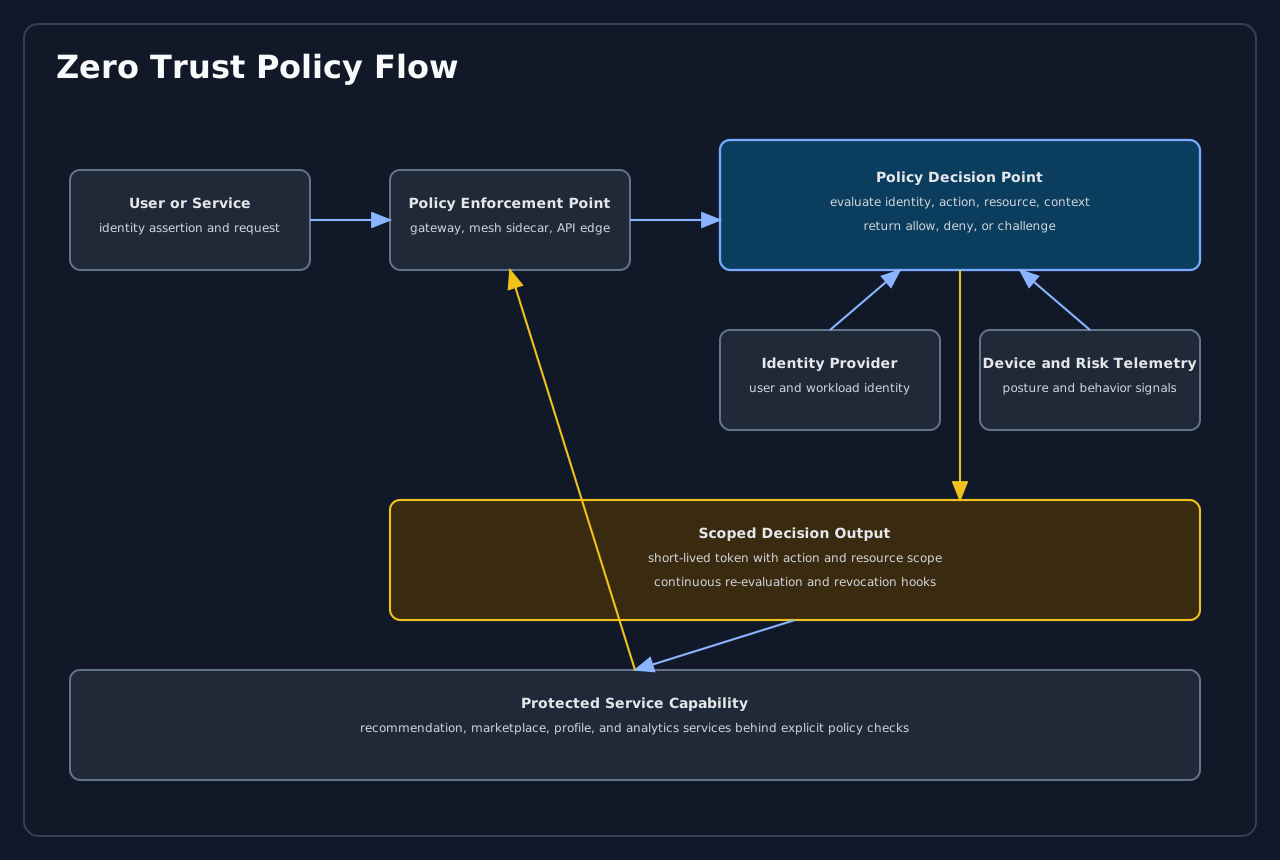
The diagram shows policy decision, policy information, and policy enforcement flow for user and service requests.
Zero Trust in the Handbook Scenario
A concrete mapping for the scenario:
- user login and profile actions require MFA and risk-aware tokens
- recommendation API calls require user scope and device posture checks
- internal scoring services require workload identity and method-level policy
- marketplace reservation actions require stronger policy step-up and short TTL tokens
- analytics ingestion services use isolated service identities with one-way access rules
This mapping keeps security policy close to capability boundaries. It aligns security design with architecture boundaries.
How It Works
A practical request lifecycle in Zero Trust Architecture:
Step 1. Identity proof. The actor presents user credentials, workload certificate, or federated token.
Step 2. Context collection. Policy Information Points provide device posture, session risk signals, geolocation, and prior behavior context.
Step 3. Policy evaluation. Policy Decision Point evaluates resource, action, identity, context, and policy rules.
Step 4. Decision and token issue. Decision can be allow, deny, or challenge. Allowed decisions get scoped short-lived authorization artifacts.
Step 5. Enforcement. Policy Enforcement Point validates token scope and applies route-level or method-level control.
Step 6. Continuous telemetry. Runtime signals feed back into policy evaluation. Behavior drift can revoke session scope.
Step 7. Audit and response. All decisions and enforcement outcomes are logged for investigation and compliance controls.
Rollout Strategy for an Existing Platform
Many teams cannot redesign all access paths in one quarter. A phased plan works better.
Phase 1. Inventory and classification. Catalog identities, assets, APIs, services, and data sensitivity classes.
Phase 2. Critical boundary hardening. Apply strong authentication and explicit policy at high-risk boundaries first.
Phase 3. Service identity normalization. Replace shared credentials with per-service workload identities.
Phase 4. Policy centralization and policy as code. Move static access rules into versioned policy repositories.
Phase 5. Micro-segmentation and lateral movement controls. Define service communication policy and isolate high-risk zones.
Phase 6. Continuous verification and response automation. Integrate telemetry-driven policy updates and revocation workflows.
Architecture Guardrails
A Zero Trust program fails when controls are partial or inconsistent. Useful guardrails:
- no network location as standalone trust factor
- no long-lived broad-scope service token
- no shared static secrets for cross-service access
- no unmanaged direct path around Policy Enforcement Points
- no critical service without auditable policy decisions
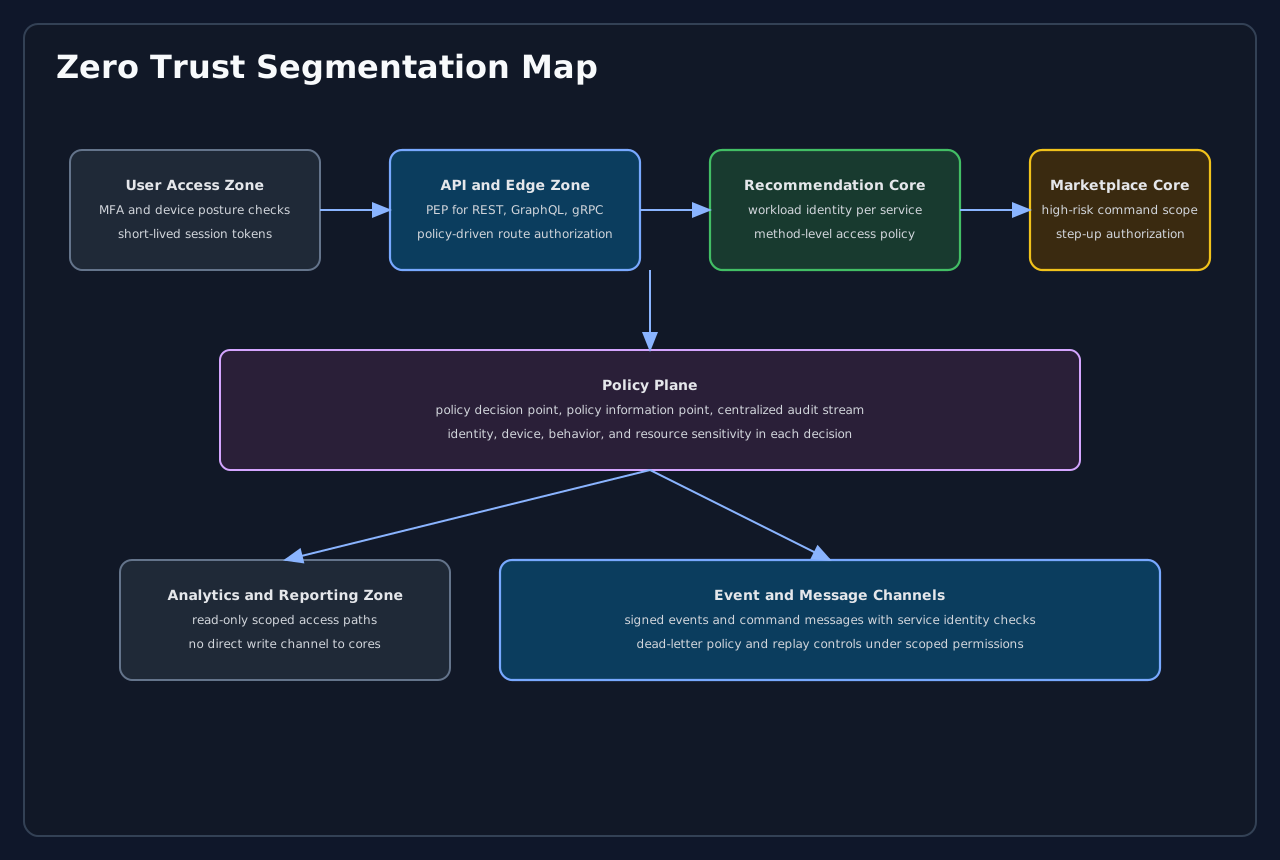
The diagram shows identity-aware segmentation between user zone, API zone, recommendation core, and marketplace core.
Challenges and Shortcomings
Zero Trust Architecture raises security posture and introduces operational complexity. Teams should account for this cost early.
Common challenges:
- policy sprawl with weak ownership and review process
- access latency growth from heavy policy chains
- integration friction with legacy services that expect network trust
- weak identity hygiene that breaks policy quality
- partial rollout that leaves unmanaged bypass paths
Governance risk is significant. A policy platform without disciplined review can create inconsistent controls. A disciplined rollout needs architecture, platform, operations, and product collaboration.
Zero Trust is not one product purchase. It is an architecture and operating model. The model must be tied to system boundaries, identity quality, and continuous verification.
Link to Existing Handbook Concepts
| Concept | Why? |
|---|---|
| Abstraction and Boundaries | Zero Trust decisions happen at explicit architecture boundaries. |
| Onion Architecture | Hexagonal Architecture. Security policy enforcement belongs in adapters and boundary layers, with core policies protected from tool lock-in. |
| Hexagonal Architecture | Hexagonal Architecture. Security policy enforcement belongs in adapters and boundary layers, with core policies protected from tool lock-in. |
| Service Contracts with REST | Service Contracts with GraphQL, and Service Contracts with gRPC. Security semantics must be part of contract behavior for each interaction style. |
| Service Contracts with GraphQL | Service Contracts with GraphQL, and Service Contracts with gRPC. Security semantics must be part of contract behavior for each interaction style. |
| Service Contracts with gRPC | Service Contracts with GraphQL, and Service Contracts with gRPC. Security semantics must be part of contract behavior for each interaction style. |
| Message-Driven Architecture | Event-Driven Messaging. Service identities and policy scope must cover asynchronous channels, not only synchronous APIs. |
| Event-Driven Messaging | Event-Driven Messaging. Service identities and policy scope must cover asynchronous channels, not only synchronous APIs. |
| Correctness and Testing | Policy behavior should be verified with repeatable tests and negative-path scenarios. |
| Resilience and Recovery | Zero Trust controls support containment and reduce incident blast radius. |
Written by: Pedro Guzmán
See References for complete APA-style bibliographic entries used on this page.