Modern Monolith Architecture
Core Idea
Examples and diagrams in this page follow the shared Hypothetical Scenario.
A modern monolith is one deployable application with explicit internal module boundaries, clear ownership, and strict architecture rules. It is not a large unstructured codebase. It is a boundary-driven design that keeps domain cohesion high and operational complexity controlled.
The pattern treats modularity as a first-class concern. A single runtime and one deployment unit reduce infrastructure overhead. Internal boundaries preserve long-term maintainability. This makes the model strong for early and mid-stage product evolution.
In the handbook scenario, profile management, recommendation logic, and marketplace orchestration can start in one modular codebase. Each domain module can keep its own use cases and data contracts. The team gains fast delivery speed with strong architecture discipline.
Historical Context
Early enterprise systems often started as monoliths without boundary discipline. The resulting coupling created the term "big ball of mud" in architecture discussions. Domain-Driven Design in 2003 gave a practical way to structure modules by business language and boundaries. Industry practice later reframed the monolith as a valid first architecture choice when designed with explicit modular contracts.
Sources: Evans (2003), Foote and Yoder (1999), and Fowler (2015)
The Problem It Solves
Teams often face a hard choice at project start. One option is a distributed architecture from day one. Another option is a simple monolith with weak structure. Both options can fail.
Early microservice rollout can overload teams with operational work. Service discovery, tracing, CI pipelines, identity policy, and distributed failure modes require mature platform capability. Small teams can lose feature velocity under this overhead.
Traditional unstructured monoliths fail in a different way. Business rules spread across shared utility layers. Module boundaries blur. Change risk grows with every release. The system becomes a distributed monolith candidate before any service split.
A modern monolith solves this dilemma. It gives one runtime and one deployable artifact. It still enforces strict domain boundaries, interface contracts, and architecture tests. This keeps complexity proportional to team maturity and product stage.
Main Concept
A modern monolith has four core traits.
Explicit Domain Modules
Code is organized by business capabilities, not technical layers only. Each module owns its use cases, policies, and data access boundaries. Cross-module calls use explicit contracts.
Internal Ports and Adapters
Hexagonal concepts still apply inside a monolith. Each module can define driving and driven ports. Adapters implement framework and persistence details. This keeps business logic independent from tool choices.
Architecture Governance
Boundary rules are verified by automated tests. Compile-time dependency direction is explicit. Forbidden imports are blocked in CI. This prevents silent coupling drift.
Operational Simplicity with Design Rigor
One deployment unit simplifies release coordination. Observability, rollback, and debugging are easier than in distributed systems. Rigor still comes from module-level contracts and ownership discipline.
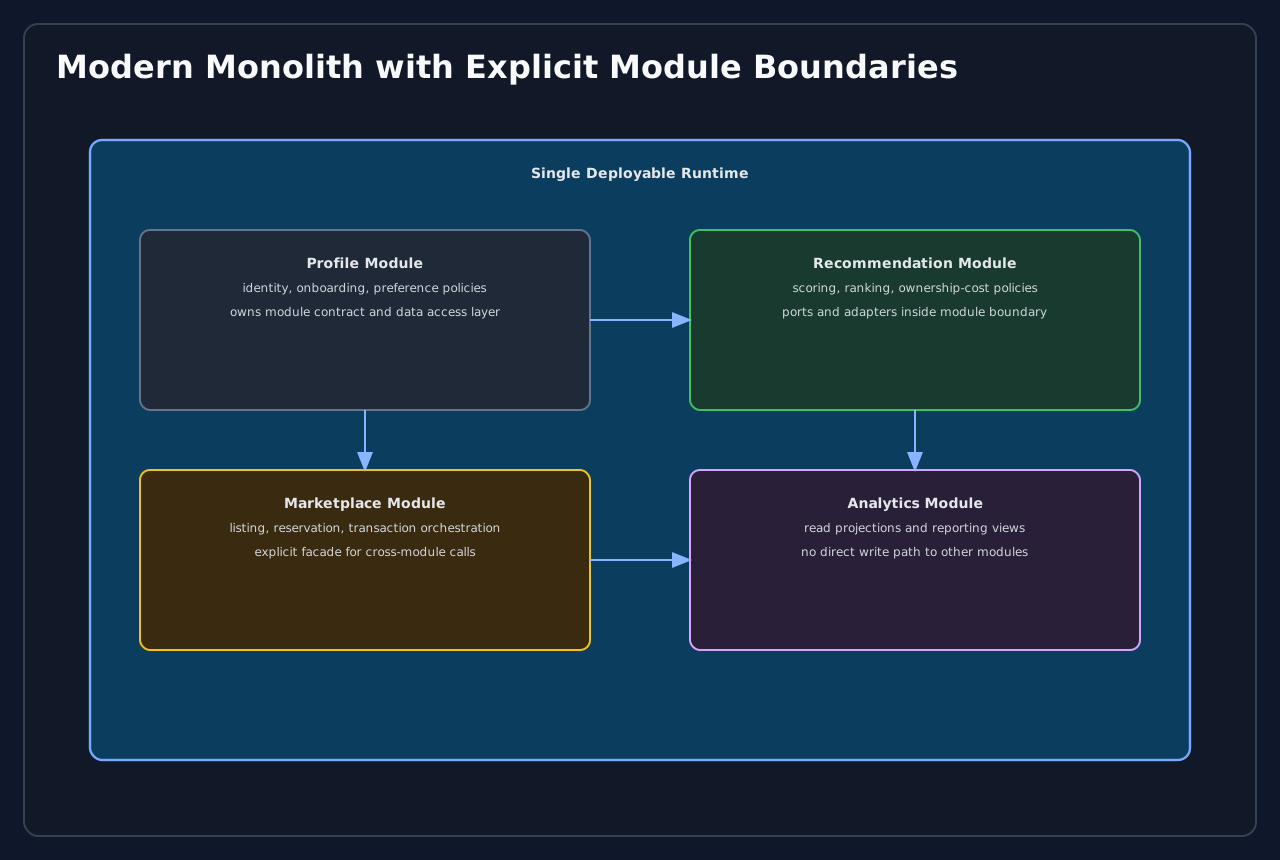
The diagram shows one deployable runtime with strict module contracts.
Monolith-First, Not Monolith-Forever
A modern monolith does not block future decomposition. It prepares decomposition. Clean module boundaries can become service boundaries when scale and ownership justify the split. This approach is often called monolith-first strategy.
How It Works
A practical implementation flow:
Step 1. Define bounded contexts in domain language. Start with major capabilities such as profile, recommendation, and marketplace.
Step 2. Create module contracts. Define what each module exposes and what each module can consume.
Step 3. Keep data ownership explicit inside the monolith. Shared database use is common. Shared table writes across modules should be constrained by contract.
Step 4. Apply ports and adapters in each module. Framework code and persistence code stay at module boundaries.
Step 5. Add architecture tests. Reject forbidden cross-module imports and dependency direction violations.
Step 6. Add module-level contract tests. Verify behavior and error semantics at module boundaries.
Step 7. Add release and ownership conventions. Each module has maintainers and review rules.
Step 8. Track decomposition signals. High independent change rate, scaling asymmetry, and ownership friction can indicate service extraction readiness.
A practical module map for the scenario:
- profile module with onboarding, preference models, and identity bindings
- recommendation module with scoring policies and ranking strategies
- marketplace module with listing and reservation workflows
- analytics module with read-oriented reporting projections
Each module can keep internal cohesion high and external coupling low.
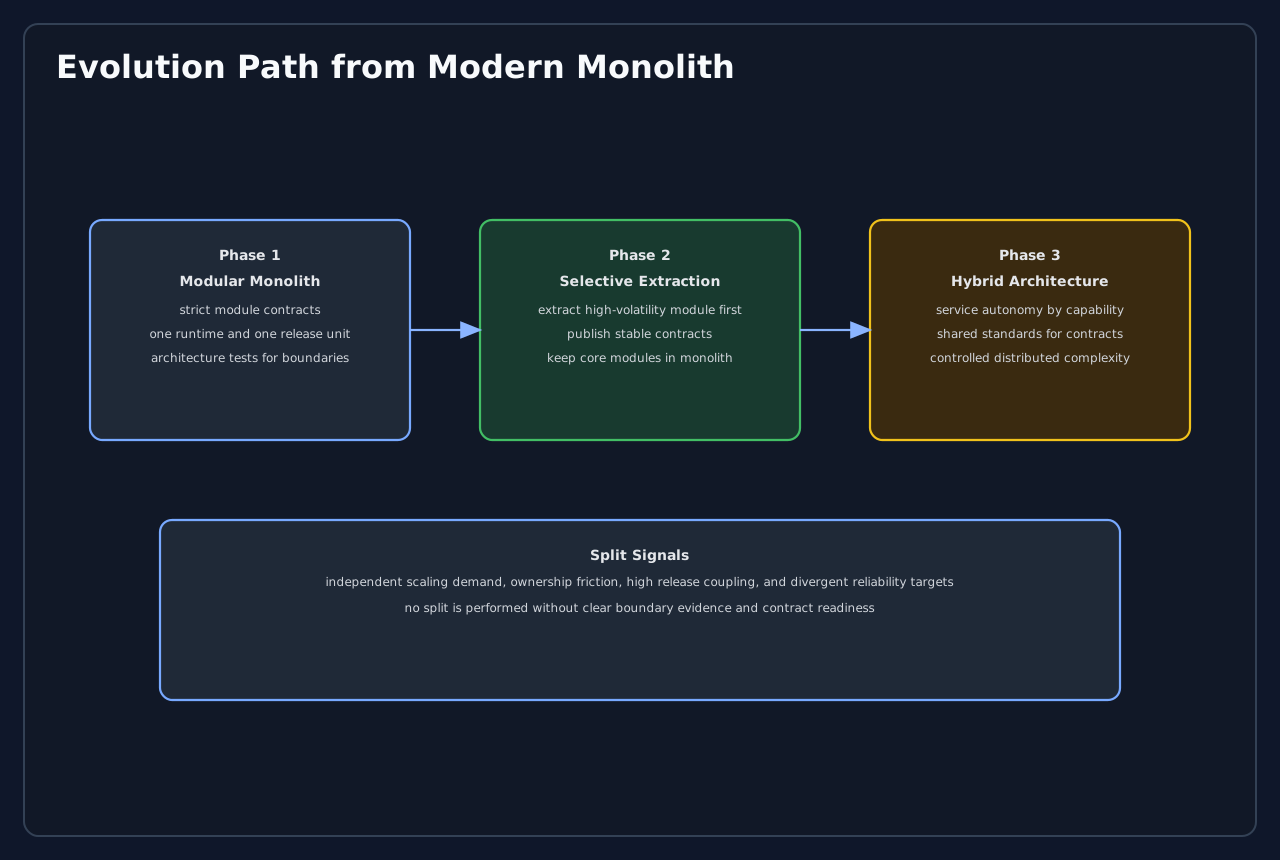
The diagram shows phased growth from modular monolith to selective service extraction.
Challenges and Shortcomings
A modern monolith can degrade without discipline. The runtime is single. A bad boundary can affect large code areas quickly. Teams need governance and review rigor.
Common risks:
- shared utility packages becoming hidden coupling channels
- cross-module direct database writes that bypass module contracts
- weak ownership of module contracts
- delayed refactoring of module boundaries after domain change
- assuming one deployment unit can scale every workload efficiently
There is a growth limit for one deployable unit. Independent scaling and independent release may become necessary in later stages. The model is strong when teams monitor split signals and plan extraction deliberately.
Link to Existing Handbook Concepts
| Concept | Why? |
|---|---|
| Hexagonal Architecture | Modern monolith modules can apply ports and adapters internally. |
| Onion Architecture | Dependency direction and policy protection still apply in one runtime. |
| Onion and Hexagonal Together | The combined model works in monolith and distributed forms. |
| State and Data Modeling | Module-level data ownership and invariant control are central. |
| Correctness and Testing | Architecture tests and contract tests keep boundary quality stable. |
| Microservices Architectural Style | This page explains when and how teams can move from modular monolith to service boundaries. |
Written by: Pedro Guzmán
See References for complete APA-style bibliographic entries used on this page.